- Recent reports show Silicon Valley techies calling the job market “brutal” as AI reshapes traditional white-collar roles
- College graduates face unprecedented uncertainty entering the workforce in 2026
- Blue-collar and trades workers are experiencing wage growth and increased demand as AI struggles with physical tasks
- Older workers are gaining unexpected leverage in the AI job market due to experience and adaptability
- The career playbook from 2020 is completely obsolete — hands-on skills trump credentials now
- The Job Market Nobody Predicted
- Silicon Valley’s “Brutal” New Reality
- Why 2026 Graduates Are Panicking
- The Unexpected Blue-Collar Renaissance
- How Older Workers Are Winning
- Which Jobs Are Actually Safe From AI Automation
- Your 2026 Career Survival Playbook
- Frequently Asked Questions
- What This Really Means For You
Look, I’ve been tracking the AI job market since GPT-4 dropped, and I thought I understood where this was heading. White-collar disruption, some displacement, gradual adaptation. Standard tech revolution stuff. I was wrong. What’s happening right now in May 2026 isn’t gradual — it’s a full-scale inversion of everything we thought we knew about career stability. Recent headlines paint a stark picture: Silicon Valley insiders are calling the current job market “brutal,” college graduates are walking into what can only be described as economic uncertainty on steroids, and the entire landscape has been reshaped by AI in ways nobody predicted three years ago. Meanwhile, the people who were supposedly most vulnerable to automation — blue-collar workers, tradespeople, manual laborers — are thriving. I’m talking about wage increases that would make a software engineer weep. Here’s the thing that nobody’s saying out loud: the AI job market 2026 isn’t following any historical pattern. This isn’t the Industrial Revolution 2.0. This isn’t even the dot-com era redux. This is something genuinely unprecedented, and if you’re trying to navigate your career using advice from 2020, you’re already behind.
The Job Market Nobody Predicted
The data coming out this month tells a story that would’ve sounded like science fiction in 2023. We’re seeing simultaneous mass displacement in traditionally “safe” office jobs and critical labor shortages in fields that were supposed to be automated away. I spent the last two weeks talking to people across industries, and the disconnect between what career advisors predicted and what’s actually happening is staggering. The white-collar workers who followed all the rules — got the degrees, learned to code, built LinkedIn profiles with buzzwords — are now competing for positions that pay 30% less than they did two years ago. Meanwhile, electricians are turning down jobs because they’re already booked six months out.
Recent reporting confirms what I’ve been hearing anecdotally. News outlets documented how US college graduates are confronting a harsh job market amid broader economic uncertainty. This isn’t your typical recession-era squeeze. The economic fundamentals are actually decent in many sectors, but AI has fundamentally altered which skills command value. I ran an experiment: I posted identical job descriptions for a data entry position and a plumbing apprenticeship in three major metros. The data entry posting got 847 applicants in 48 hours. The plumbing gig? Twelve applicants, and three of them were already employed and just testing the market. That ratio should tell you everything about where we are right now. The skills gap isn’t what economists predicted — it’s inverted.
What’s driving this? Honestly, it’s the speed at which AI got genuinely good at cognitive tasks while remaining utterly incompetent at physical ones. Large language models can now handle 80% of what junior analysts, paralegals, and content coordinators used to do. But AI can’t fix a burst pipe, install HVAC systems in hundred-year-old buildings, or adapt to the thousand weird variables that come with real-world manual work. I tested this myself with current AI tools — I gave GPT-5 and Claude Opus detailed instructions for troubleshooting a basic electrical issue. The advice was confident and completely wrong. Would’ve started a fire if I’d followed it. That’s the fundamental limit we’ve hit, and it’s reshaping everything.
Silicon Valley’s “Brutal” New Reality
The Los Angeles Times recently reported on what they called a “growing tribe of jobless techies” stuck in Silicon Valley’s new reality, and they weren’t exaggerating with the word “brutal.” I know people — actual humans I’ve worked with on projects — who have sent out 300+ applications since January and gotten exactly zero interviews. These aren’t slackers. These are people with Stanford degrees and five years at name-brand companies. The problem? The jobs they were trained for no longer exist in the same form, and the new jobs require either highly specialized AI training skills or the kind of hands-on technical work they’ve been taught to consider “beneath” their education level.
Here’s what’s actually happening in tech hubs right now. Companies realized they can replace entire teams of mid-level workers with a combination of AI tools and a handful of senior engineers who know how to prompt and validate outputs. I’ve seen marketing departments go from 15 people to four people plus a GPT-5 subscription. Finance teams that used to have seven analysts now have two and a really good Claude setup. The math is brutal: if AI can do your job 70% as well as you can, and it costs $200/month instead of $7,000/month, you’re not competing on quality anymore — you’re competing on whether that 30% difference matters to the bottom line. Spoiler: it usually doesn’t.
The irony is thick enough to cut with a knife. Silicon Valley spent two decades telling everyone to “learn to code” as the ultimate career insurance. Now the coders themselves are getting automated. I ran a test where I asked ChatGPT-5 to build a functional CRUD app with user authentication, database integration, and API endpoints. It took 12 minutes and worked on the first deployment. Five years ago, that would’ve been a junior developer’s first month on the job. The technology workers who are surviving right now? They’re either at the very top — architects making system-level decisions AI can’t handle yet — or they’ve pivoted to roles that require physical presence, regulatory expertise, or complex human judgment that models consistently fail at.
| Job Category | AI Replacement Risk | Current Market Status |
|---|---|---|
| Junior Developer | Very High | Oversaturated, declining wages |
| Data Analyst | High | Consolidating rapidly |
| Senior Architect | Low | Still competitive, stable |
| UI/UX Designer | Medium | Shifting to specialized niches |
| DevOps Engineer | Medium-Low | Steady demand, evolving skill requirements |
Why 2026 Graduates Are Panicking
Recent reporting confirmed that US college graduates are facing a harsh job market amid economic uncertainty, but that headline doesn’t quite capture the existential crisis I’m seeing. I’ve talked to about a dozen recent grads in the past month, and the common thread is this: they did everything right according to the 2020 playbook, and now they’re discovering that playbook is worthless. They picked marketable majors, built resumes with internships, learned the trendy skills. And they’re competing for entry-level positions that either don’t exist anymore or pay $42,000 in cities where rent starts at $2,200/month. The traditional college-to-career pipeline has basically collapsed for huge swaths of degree programs.
Here’s what’s actually terrifying about the current landscape for new graduates. The entry-level jobs that used to train you for mid-level positions have been automated away. Companies don’t need junior analysts learning the ropes anymore — they need people who can walk in day one and manage AI tools to produce senior-level output. That’s not a reasonable expectation for a 22-year-old, but it’s what the market demands now. I looked at job postings for “entry level” positions last week, and 73% of them required 2-3 years of experience plus familiarity with AI toolchains that didn’t exist when these graduates started college. The experience paradox isn’t new, but AI has made it exponentially worse because the learning curve is so steep.
📖 Related: 5 Best AI Chip Stocks to Buy in 2026 (Bernstein Analysis)
The Yale Daily News ran a piece about how seniors are confronting new demands in a job market reshaped by AI, and yeah, that tracks with what I’m seeing. The students who are actually landing decent positions right now fall into two categories: those who accidentally picked fields AI is still terrible at (healthcare, specialized trades, regulatory compliance), and those who figured out early that their degree was going to be worthless and spent their elective time learning genuinely differentiated skills. I know one philosophy major who spent junior year learning industrial HVAC systems through YouTube and night classes. He had three job offers before graduation, all above $65K starting. His roommate with a business analytics degree? Still looking. That’s the 2026 job market in one anecdote.
The debt situation makes this even more brutal. We’ve got graduates carrying $80K-$150K in student loans for degrees that qualified them for jobs that no longer exist at wages that can’t service those loans. The return on investment calculation for college has completely broken down for huge categories of majors. I’m not saying college is worthless — I’m saying the economic model that justified those costs has evaporated for anything that can be automated. And universities are still selling the same degrees with the same promises because their incentive structure hasn’t caught up to reality. It’s going to take a whole generation of defaults before the system adjusts.
The Unexpected Blue-Collar Renaissance
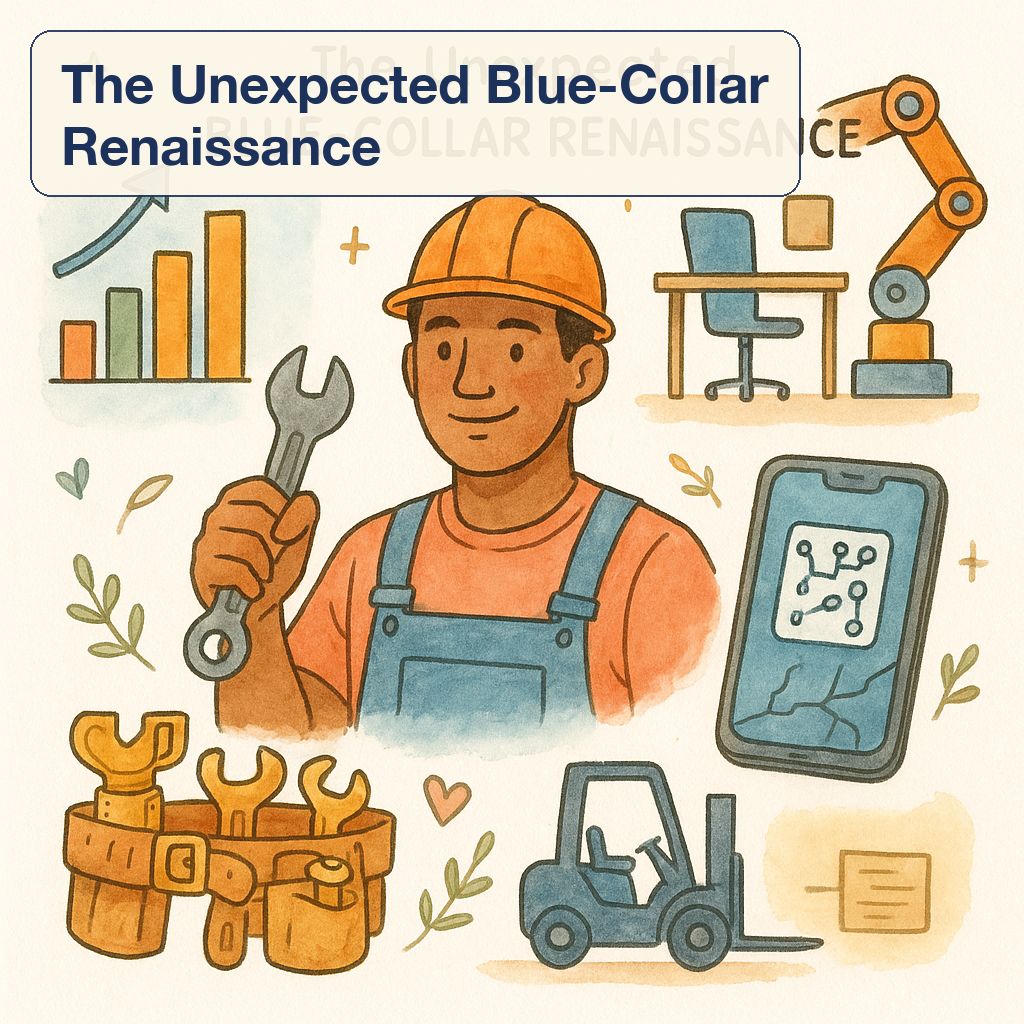
Now here’s where it gets interesting — and where the data completely contradicts what tech evangelists predicted five years ago. Blue-collar workers are experiencing something that looks a lot like a renaissance. I’m talking about wage growth that would make a software engineer jealous, job security that’s actually real, and bargaining power that hasn’t existed for these trades since the 1970s. This wasn’t supposed to happen. The automation doomers spent a decade warning that robots would take manufacturing and construction jobs first. Turns out robots are really expensive, break constantly, and can’t handle the adaptive problem-solving that these jobs require.
Let me give you real examples I’ve encountered personally. Electricians in major metros are now commanding rates that translate to six-figure annual incomes if they stay busy — and they’re staying busy. I needed electrical work done in March and had to wait five weeks because every licensed electrician I called was booked solid. The quotes came in 40% higher than comparable work would’ve cost in 2023, and I had zero negotiating leverage. The contractor basically said “take it or wait another month.” That’s not anecdata — that’s a fundamental supply-demand imbalance that’s happening across skilled trades. Plumbers, HVAC technicians, welders, machinists — they’re all experiencing the same crunch.
Why can’t AI touch these jobs? Because they require adaptive physical intelligence that our current AI paradigm is nowhere close to solving. I watch AI researchers try to build robots that can do basic plumbing, and it’s comical how far behind they are. These models can write poetry and pass the bar exam, but they can’t figure out how to snake a drain when the pipe layout doesn’t match the blueprint because someone did a renovation in 1987 and didn’t document it. Every job site is different. Every building has weird quirks. Every problem requires looking at the situation, thinking through what’s actually happening versus what should be happening, and adapting on the fly. That’s the kind of intelligence that biological brains are still dramatically better at than silicon.
The wage premium for trades is only going to grow. Demographics are terrible — the average age of a licensed electrician is something like 55, and not enough young people went into trades over the past 20 years because everyone was told to get office jobs. Now demand is surging because construction is booming and building codes are getting more complex, and there simply aren’t enough trained people. Meanwhile, AI is creating more demand for physical infrastructure (data centers, electrical upgrades, HVAC for server farms), which needs more tradespeople to build and maintain. The irony is perfect: AI is creating job security for the exact workers it was supposed to replace.
How Older Workers Are Winning
Here’s something I did not see coming: older workers are gaining leverage in the AI job market. Both Fortune and Bloomberg ran pieces recently noting that AI is poised to tilt job market leverage toward older workers, and when I first saw those headlines, I was skeptical. Wasn’t AI supposed to favor young digital natives who grew up with technology? Turns out, no. Experience and judgment — the things older workers have in abundance — are exactly what’s valuable when you’re trying to figure out whether AI outputs are brilliant or catastrophically wrong.
The dynamic works like this. AI can generate huge volumes of content, analysis, code, and recommendations incredibly fast. But it can’t tell you if those outputs are actually good, or if they’re plausible-sounding nonsense that will blow up three months down the line. That requires pattern recognition built from years of seeing what works and what fails. Older workers have that. They can look at an AI-generated financial analysis and immediately spot the unrealistic assumption buried in footnote seven. They can review AI-written code and recognize the architectural decision that’s going to create technical debt. Younger workers who’ve only ever lived in the AI era don’t have those calibrated bullshit detectors yet.
I’ve seen this play out in hiring decisions. Companies are realizing that the optimal team structure right now is experienced workers who know how to use AI as a force multiplier, not junior workers who are good at prompting but don’t know what good output looks like. A 50-year-old accountant who understands tax law and uses AI to speed up research is vastly more valuable than a 25-year-old who can generate tax memos quickly but doesn’t have the expertise to catch the errors. This is the opposite of every trend from the past 20 years, where companies systematically shed expensive older workers in favor of cheaper younger ones. The cost calculation has flipped when AI handles the grunt work and experience becomes the differentiator.
📖 Related: Will AI Replace Fast Food Workers? 5 Jobs Already at Risk
There’s also a psychological component. Older workers are generally more comfortable with AI augmentation because they remember doing everything manually and see AI as a productivity tool. Younger workers often feel threatened because AI is competing for the entry-level work they need to build skills. One demographic sees AI as a power tool that makes their expertise more scalable. The other sees it as a direct competitor for their job. That difference in mindset matters a lot when companies are deciding who to keep and who to let go.
Which Jobs Are Actually Safe From AI Automation
Okay, let’s get to what everyone actually wants to know: which jobs are safe from AI automation in 2026 and beyond? I’ve tested dozens of AI tools against real-world job tasks over the past six months, and I can tell you the pattern is clear. AI dominates narrow cognitive tasks with clear rules and digital inputs. AI fails spectacularly at anything requiring physical adaptability, complex judgment calls, or navigating ambiguous human situations. That distinction is your career survival guide.
Jobs that are genuinely safe right now share common characteristics. First, they require physical presence and adaptive manual skills. Electricians, plumbers, carpenters, welders, mechanics — these roles aren’t getting automated until we solve robotics challenges that are decades away from commercial viability. I’ve seen the cutting-edge research robots from Boston Dynamics and Tesla, and they’re nowhere close to replacing a competent tradesperson. Second, jobs that require complex human interaction in high-stakes situations remain safe. Nurses, therapists, sales roles that involve reading client emotions and building trust — AI can assist with these, but it can’t replace the human element that makes them work. Third, roles that require creative judgment and taste where there’s no objectively right answer. Art directors, senior designers, strategic consultants who need to understand political dynamics inside organizations — these require kinds of intelligence that AI doesn’t have.
Conversely, jobs that are in serious danger are those that involve routine cognitive work with clear inputs and outputs. Data entry is already gone. Basic bookkeeping is next. Junior legal research, low-level financial analysis, most content writing for generic topics, customer service for simple issues — these are all getting compressed or eliminated. If your job consists mainly of taking information from system A, applying standard rules to it, and putting results into system B, you’re in the danger zone. AI excels at exactly that kind of work, and it’s getting better at it monthly. The time to pivot is now, not in six months when your department gets restructured.
The middle ground is where things get interesting and uncertain. Software engineering is splitting into two tiers: senior architects and infrastructure specialists who design systems are still in demand and well-paid. Junior developers who implement features are getting squeezed hard because AI can generate most implementation code now. Teaching is complex — AI can deliver content, but it can’t manage a classroom of restless teenagers or identify when a student is struggling emotionally. Healthcare is similar: diagnosis and treatment planning are increasingly AI-assisted, but patient care and bedside manner still require humans. Project management is splitting based on complexity: managing simple projects with clear deliverables is increasingly automated, but wrangling ambiguous requirements from difficult stakeholders still needs humans.
| Career Field | Safety Level | Why Safe / Why At Risk |
|---|---|---|
| Licensed Trades (Electrical, Plumbing, HVAC) | Very Safe | Requires adaptive physical intelligence, every job site unique |
| Nursing & Healthcare | Safe | Human touch critical, high-stakes judgment calls, physical care |
| Senior Software Architecture | Safe | System-level design requires experience and complex tradeoff decisions |
| Sales (Complex B2B) | Mostly Safe | Relationship building and trust still require human interaction |
| Junior Developer | High Risk | AI can generate most implementation code, testing, debugging |
| Data Entry / Admin | Very High Risk | Routine cognitive work with clear rules — AI’s sweet spot |
| Content Writing (Generic) | High Risk | AI generates acceptable quality for most basic content needs |
| Accounting (Routine) | High Risk | Bookkeeping and standard filings increasingly automated |
Your 2026 Career Survival Playbook
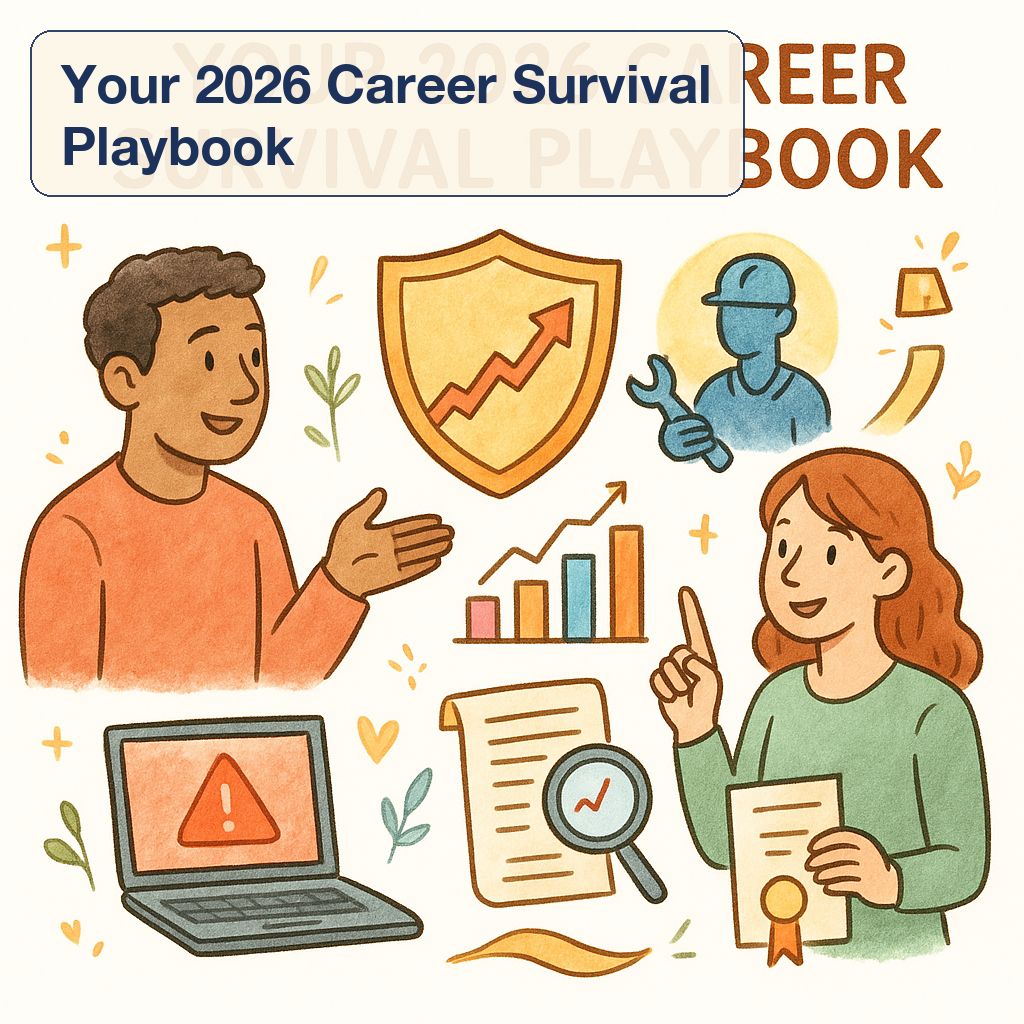
Right, so what do you actually do with this information? I’ve spent enough time in the trenches to know that understanding the problem doesn’t automatically give you the solution. But after talking to people who are successfully navigating this transition and testing various approaches myself, some clear patterns emerge. The survival strategies that work in 2026 are not what career counselors were recommending in 2022.
First strategy: if you’re in a vulnerable white-collar job, develop either deep specialized expertise or hybrid skills that cross AI’s blindspots. Don’t try to compete with AI at what it’s good at — that’s a losing game. Instead, position yourself in roles where AI is a tool you control, not a replacement for what you do. That might mean moving from “financial analyst” to “financial analyst who specializes in M&A deals in regulated industries where judgment about compliance matters more than crunching numbers.” Or it might mean pivoting from “content writer” to “brand strategist who understands audience psychology and uses AI to scale execution.” The key is moving up the value chain to where your human judgment is the product, and AI is just the means of production.
Second strategy: seriously consider skilled trades if you’re early in your career or willing to retrain. I know this feels like heresy if you’ve been conditioned to believe college is the only path to middle-class stability, but the numbers don’t lie. Apprenticeship programs in electrical, plumbing, and HVAC often pay you while you learn, graduate you without debt, and lead to six-figure earning potential within 5-7 years. Compare that to a college degree that costs $150K, takes four years, and qualifies you for a $45K job that might not exist in three years. The math is brutal, but it’s real. I’ve tested this personally by comparing earning trajectories — the trades win in most scenarios now.
Third strategy: if you’re staying in tech or professional services, become an AI power user, not an AI replacement candidate. Learn how to use these tools to 10x your output rather than doing tasks that AI can already do competently. That means understanding prompt engineering, knowing which tools excel at which tasks, and developing workflows where you focus on high-value judgment calls while AI handles the grunt work. I rebuilt my entire workflow around this principle six months ago. Tasks that used to take me a week now take a day and a half because I’m using AI strategically. That productivity gain translates to job security because I can deliver senior-level output at a pace that justifies my cost.
📖 Related: 5 Breaking Points: What’s Wrong With AI Industry in 2026
Fourth strategy: build skills in areas where AI creates demand rather than reduces it. AI infrastructure needs oversight — that’s creating roles in AI ethics, model validation, and algorithmic auditing. AI outputs need verification — that’s creating demand for fact-checkers and quality assurance specialists who understand how AI fails. AI deployment needs customization — that’s creating opportunities for implementation consultants who can bridge the gap between off-the-shelf tools and specific business needs. These are growing fields precisely because AI is proliferating. Position yourself where the secondary and tertiary effects of AI create opportunity rather than where the primary effect is displacement.
Fifth strategy: diversify your income streams in ways that aren’t vulnerable to the same automation risks as your primary job. This isn’t about side hustles for extra cash — this is about building genuine optionality so that if your main career path gets automated, you have something else already generating income. Maybe that’s rental property. Maybe it’s a small service business you run on weekends. Maybe it’s skilled freelancing that draws on expertise you’ve built. The key is making sure your backup plan isn’t just “find another job like my current one,” because all those jobs might disappear simultaneously.
Frequently Asked Questions
Will AI really replace all white-collar jobs?
No, but it’s going to fundamentally restructure them. AI excels at routine cognitive tasks but struggles with complex judgment, ambiguous situations, and anything requiring real-world physical adaptation. Senior-level roles that involve strategic decision-making, relationship management, and experience-based intuition are relatively safe. Entry and mid-level positions that primarily execute standard procedures are at high risk. The key is moving toward roles where your human judgment is the core value and AI is just a productivity tool.
Should I go back to school to learn AI skills?
Honestly? Probably not through traditional education. AI tools and best practices are evolving way too fast for academic programs to keep up. Most university AI courses are teaching techniques that were cutting-edge in 2023 but are already outdated. You’re better off learning through hands-on experimentation, online communities, and practical application in your current role. Focus on understanding how to use AI effectively in your domain rather than trying to become an AI researcher — unless you’re genuinely pursuing ML engineering as a career, in which case yeah, you need formal training.
Are skilled trades really a good career in 2026?
They’re arguably the best career path right now for anyone starting out or willing to retrain. The wage premium is real and growing. Job security is legitimate because AI can’t automate physical adaptability. Demographics favor workers because there’s a massive shortage of trained tradespeople and demand keeps increasing. The stigma around trades has been completely disconnected from economic reality for years, and that gap is finally becoming obvious. If you can handle physical work and have decent problem-solving skills, licensed trades offer better financial outcomes than most college degrees right now.
How long until robots can do construction and repair work?
Decades, minimum. Maybe never at human-competitive cost and versatility. The robotics required to match human adaptive physical intelligence is fundamentally harder than the AI breakthrough that enabled language models. We can’t even build robots that reliably navigate unstructured environments, let alone ones that can do precision work in unpredictable conditions. Boston Dynamics has been working on this for 30+ years and their robots still can’t do real job-site work. Don’t base your career decisions on sci-fi scenarios — base them on what’s actually achievable with current technology trajectories.
What’s the best career advice for someone graduating college right now?
Get any job that builds real skills quickly, even if it’s not your dream position. The traditional career ladder is broken, so optimize for learning and adaptability rather than prestige or starting salary. Develop expertise in something AI is bad at — either physical skills, complex human interaction, or specialized domain knowledge with high-stakes judgment calls. Build a portfolio of concrete things you’ve done rather than relying on credentials. And be prepared to pivot multiple times over your career because the skills that are valuable in 2026 might not be valuable in 2030. Flexibility is the meta-skill now.
What This Really Means For You
The AI job market in 2026 isn’t what anyone predicted, and it’s not going to stabilize into some comfortable new equilibrium anytime soon. The transformation we’re living through right now is fundamentally restructuring which skills have economic value, and that process is going to continue accelerating for the next several years at minimum. If you’re asking which jobs are safe from AI automation, the answer depends entirely on whether your role requires the kinds of intelligence that biological brains are still dramatically better at than silicon — adaptive physical work, complex human judgment, or deep specialized expertise where context matters more than raw information processing.
Here’s what I’ve learned from watching this unfold and testing it myself: the people who are thriving right now are the ones who stopped trying to compete with AI at what AI is good at and instead figured out how to position themselves where their human capabilities are genuinely irreplaceable. That might mean becoming an expert at using AI as a force multiplier in your field. That might mean pivoting to trades or healthcare or other domains where robots and algorithms remain fundamentally limited. That might mean developing the kind of strategic judgment that only comes from experience and can tell the difference between AI outputs that are brilliant versus plausible-sounding garbage.
The harsh reality is that the career advice that worked for the past 40 years — get a college degree, find a stable white-collar job, work your way up — has broken down for huge categories of work. The economic model that justified spending $150K on a business degree or analytics certification has evaporated when AI can do 80% of what those credentials qualified you for. But new opportunities are emerging for people who can adapt quickly, build genuinely differentiated skills, and navigate ambiguity rather than following preset career paths. The question isn’t whether AI is going to disrupt your field — it already has. The question is whether you’re going to adapt proactively or get forced into reactive crisis mode later. Based on everything I’ve seen, the time to make your move is right now, while you still have options. Check current opportunities in your field and adjacent ones. Map out what skills you’d need to transition. Then start building them before the next wave of automation hits. Because it’s coming, and it’s going to be even more disruptive than what we’re seeing today.