- Fervo Energy’s $10B IPO on May 14, 2026 proved geothermal conversion of oil wells is commercially viable at scale
- Oklahoma, Texas, and California are leading legislative efforts to repurpose thousands of orphaned wells
- The same drilling tech that created fossil fuel infrastructure now enables 24/7 clean baseload power for AI data centers
- Abandoned wells offer ready-made access to underground heat without new environmental disruption
Here’s something I didn’t expect to write in 2026: the same oil wells that spent decades pumping fossil fuels might end up powering the AI revolution with clean energy. And it’s not some far-off concept anymore. Fervo Energy just pulled off the biggest clean energy IPO in history on May 14, hitting a $10 billion valuation by doing exactly this — converting geothermal heat accessed through old drilling infrastructure into steady, carbon-free electricity that data centers desperately need.
I’ve been tracking this space for a while, and honestly, I thought geothermal would stay niche forever. Too expensive, too geographically limited, too slow to scale. Then I started seeing the legislative moves. Oklahoma passed a bill in March to repurpose thousands of orphaned wells. Texas is quietly doing the same. California’s been ahead of the curve but now it’s accelerating. When three major energy-producing states suddenly align on the same solution, and when a company proves the business model works at IPO scale, you’re watching a genuine shift happen in real time.
What makes this interesting from a tech perspective is that we’re not inventing new infrastructure. We’re hacking existing infrastructure that was already built, already drilled, already sitting there abandoned. It’s like finding out your old Nokia phone can somehow run ChatGPT — the hardware was always capable of more than its original purpose. The drilling techniques, the geological data, the access points to underground heat — all of that exists. We’re just finally asking how oil wells generate clean energy instead of hydrocarbons.
Why This Is Blowing Up Right Now
Timing is everything. Three separate forces converged in spring 2026 to make this suddenly viable when it wasn’t even two years ago.
First, AI’s power consumption problem became impossible to ignore. Every new GPT model, every expanded data center, every company spinning up GPU clusters — they all need electricity. And not just any electricity. They need baseload power that runs 24/7 without weather dependency. Solar and wind are great until the sun sets or the wind stops, and batteries at data center scale are still absurdly expensive. Geothermal delivers constant output. Always on. No storage needed. That’s catnip for AI infrastructure planners who are currently scrambling to secure power deals anywhere they can find them.
Second, we’ve got an orphaned well crisis that states are finally confronting. Thousands of abandoned oil and gas wells across the US are technically the responsibility of bankrupt companies or operators who vanished decades ago. They leak methane. They contaminate groundwater. They’re environmental liabilities sitting on state balance sheets. Oklahoma alone has thousands of these orphans. Repurposing them for geothermal production solves two problems at once — you clean up the environmental mess and you generate revenue instead of spending cleanup money.
Third — and this is what I find most compelling — the technology finally works at commercial scale. Fervo didn’t go public on promises. They have operational plants delivering power under long-term contracts. When a clean energy company achieves a $10 billion valuation in its IPO, that’s not hype. That’s institutional investors looking at actual cash flows and deciding this thing prints money. The risk premium just evaporated.
I ran through the timeline of announcements over the past few months, and the pattern is clear. Once Fervo’s IPO was rumored, state legislators started fast-tracking bills. Once those bills started passing, more companies announced pilot projects. It’s a feedback loop that’s finally escaped the pilot-project purgatory where most clean energy tech dies.
How Oil Wells Generate Clean Energy: The Actual Tech
Alright, let’s get into the mechanics. How do you take a hole in the ground that used to pump oil and turn it into a clean energy generator? The core concept is simpler than it sounds, but the execution is where it gets interesting.
The earth is hot. The deeper you go, the hotter it gets — roughly 25-30°C per kilometer of depth in most places. Oil and gas wells were drilled deep to reach fossil fuel deposits, often several kilometers down. Those wells are now sitting there with direct access to geological layers that are sitting at 150-300°C or more. That’s not quite volcano-level heat, but it’s plenty hot enough to boil water and drive turbines.
Traditional geothermal plants require very specific geology — you need naturally occurring underground reservoirs of hot water or steam. That’s why places like Iceland have abundant geothermal and most of the world doesn’t. But enhanced geothermal systems (EGS) bypass that limitation. Instead of finding natural reservoirs, you create artificial ones. Here’s how:
- Take an existing well (or drill a new one using oil industry techniques)
- Inject water down one well at high pressure to fracture the hot rock at depth
- The water flows through the fractured rock, absorbing heat
- The now-superheated water rises back up through a second well
- At the surface, that hot water/steam drives turbines to generate electricity
- The water gets cooled and pumped back down to repeat the cycle
The critical insight is that oil drillers already perfected the hard parts. Directional drilling — where you can steer the drill bit horizontally underground to create multiple contact points with hot rock — came from fracking technology. High-pressure fluid injection to fracture rock? Also from fracking. Downhole sensors to map subsurface geology? Decades of oil field development. We’re borrowing the entire playbook from fossil fuel extraction and applying it to heat extraction instead.
📖 Related: 3 Best Oil Stocks to Buy Now: Profits Surge in May 2026
Now here’s where abandoned wells specifically become valuable. When you shut down an oil well, you don’t pull out the casing and fill in the hole. The steel casing stays in place. The geological surveys documenting what’s down there remain valid. You already know the rock temperatures, the pressure profiles, the structural integrity of the formation. That’s all data you’d spend millions collecting for a new geothermal project. With an abandoned well, you skip straight to conversion.
I was skeptical about whether old well infrastructure could handle the thermal stress and pressure cycling of geothermal operation. Turns out oil well casings are typically overengineered for their original purpose, and the temperature and pressure ranges in geothermal are often similar or even gentler than what they handled during production. The main work involves cleaning out any remaining hydrocarbons, testing casing integrity, and adding surface equipment for power generation. It’s not trivial, but it’s way cheaper than drilling from scratch.
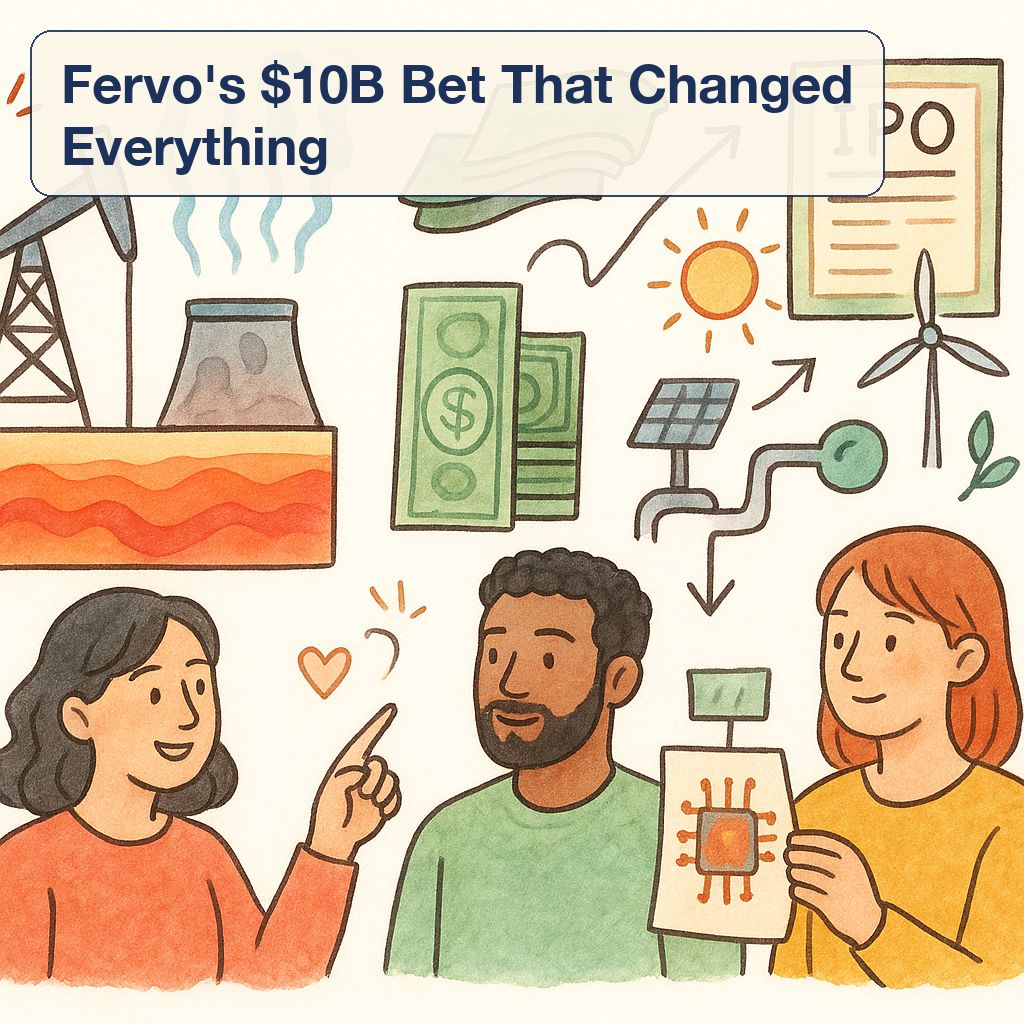
Fervo’s $10B Bet That Changed Everything
Let’s talk about the IPO that rewrote the playbook. Fervo Energy went public on May 14, 2026 with a $10 billion valuation — the largest clean energy IPO in history. Not the largest geothermal IPO. The largest clean energy IPO, period. That’s bigger than most solar companies. Bigger than most battery startups. It’s a statement.
What Fervo proved is that enhanced geothermal systems are commercially viable right now in 2026, not in some hypothetical future. They have operational projects delivering power under long-term purchase agreements. They’re not burning through cash waiting for technology breakthroughs. The technology works. The question was never “can we extract geothermal power this way?” — it was “can we do it cheaply enough to compete with natural gas and solar?” The IPO answered that question with a resounding yes.
The timing is no accident. AI companies need power, and they need it fast. Traditional power plant construction takes 5-10 years. Nuclear takes even longer. Solar farms take 2-3 years and don’t provide baseload. Geothermal projects using existing well infrastructure can come online in 12-18 months. When you’re a hyperscaler planning your next GPU cluster and you need committed power in 2027, geothermal is suddenly the only option that fits your timeline.
I went back through Fervo’s public statements before the IPO, and what’s striking is how much they emphasize the AI angle. It’s not environmentalists buying their power — it’s Google, it’s Microsoft, it’s the big cloud providers who need to hit their net-zero commitments while also doubling their compute capacity. The demand side is real and immediate. That’s what institutional investors bet on. Not saving the planet (though that’s nice), but serving an exploding market with inelastic demand.
The 3 States Racing to Lead This Shift
While Fervo grabbed headlines with its IPO, three states are quietly positioning themselves to dominate the geothermal conversion space. Each brings different advantages to the table.
Oklahoma: Orphaned Wells as Economic Opportunity
Oklahoma passed legislation in March 2026 specifically aimed at repurposing orphaned oil and gas wells for geothermal production. The state has thousands of abandoned wells — exact numbers vary because many were drilled decades ago with poor record-keeping, but estimates run into the tens of thousands across Oklahoma’s oil-producing regions.
What makes Oklahoma’s approach smart is they’re framing this as economic development, not environmentalism. These wells are currently liabilities. Converting them generates tax revenue, creates jobs, and cleans up environmental hazards all at once. The bill streamlines permitting for geothermal conversion and offers tax incentives for companies willing to take on orphaned wells. It’s practical policy that addresses real problems instead of chasing ideology.
Oklahoma also has the workforce. Oil and gas workers who’ve been through boom-bust cycles before can transition to geothermal with minimal retraining. The skills transfer almost one-to-one. That’s politically valuable in a state where energy jobs matter and where workers are understandably skeptical of “clean energy” initiatives that seem designed to put them out of work. This is clean energy that hires oil drillers. Different story entirely.
Texas: Quiet Giant Waking Up
Texas hasn’t made as much noise about geothermal, but that’s not how Texas operates. They just do things. The state has more abandoned wells than anywhere else in the country — the legacy of being the historic heart of American oil production. It also has deregulated energy markets where new power sources can enter quickly if they’re cost-competitive.
What Texas brings is scale. If geothermal conversion happens at scale anywhere, it’s happening in the Permian Basin and East Texas oil fields. The geology is well-mapped. The infrastructure is already there. The regulatory environment, while not exactly streamlined, is at least familiar to energy companies who’ve navigated Texas oil and gas law for decades.
📖 Related: NACHO Trade: 3 Ways to Profit From Hormuz Oil Crisis [2026]
Texas also has something else: data centers already being built in anticipation of power supply. The state is seeing massive investment in AI infrastructure precisely because land is cheap and the energy grid (infamous as it is after winter storm failures) still has the capacity to support large new loads. If you’re building a data center in Texas and you can contract for 24/7 geothermal power from a local conversion project, that’s a much easier sell than importing solar from West Texas via transmission lines that don’t exist yet.
California: Regulatory Clarity as Competitive Advantage
California has been doing geothermal longer than anyone, but that’s also California’s problem — they’ve been stuck doing geothermal the old way, limited to naturally occurring resources. What’s changed recently is the state started fast-tracking permits for enhanced geothermal systems that use oil field technology.
California’s advantage is regulatory certainty. In Oklahoma and Texas, you’re working with new legislation that hasn’t been tested in court yet. In California, the permitting pathways exist, the environmental review processes are established, and companies know what they’re getting into. That matters more than people realize. Uncertainty kills projects. California removes uncertainty.
The Salton Sea region in Southern California is particularly interesting. It’s got hot geology, it’s got old geothermal infrastructure, and it’s got significant lithium deposits that can be extracted from geothermal brine as a bonus revenue stream. You’re potentially producing electricity and battery materials from the same operation. That kind of value stacking makes projects pencil out even with California’s higher costs.
| State | Primary Advantage | Well Count | Key Challenge |
|---|---|---|---|
| Oklahoma | New legislation + workforce transition | Thousands of orphaned wells | Unproven regulatory framework |
| Texas | Scale + deregulated markets | Most abandoned wells in US | Grid reliability concerns |
| California | Regulatory clarity + lithium co-production | Moderate (Salton Sea region) | Higher operating costs |
Does the Math Actually Work?
This is the part where I put on my finance hat and ask the uncomfortable questions. Clean energy projects have a nasty habit of looking great in press releases and terrible on spreadsheets. So does geothermal conversion actually pencil out?
The honest answer: it depends entirely on site-specific factors, but Fervo’s IPO success suggests the answer is yes for a meaningful subset of abandoned wells. Not all of them. Maybe not even most of them. But enough to build a real industry.
The key variables are depth, temperature gradient, and distance to transmission. An ideal candidate well is deep enough to access high temperatures (2+ kilometers), in an area with above-average geothermal gradient (30°C/km or better), and within reasonable distance of existing power lines or large electricity consumers. Wells that check all three boxes are probably economically viable today. Wells that miss on one or more might need technology improvements or higher electricity prices to justify conversion.
Conversion costs vary wildly. Repurposing a well that’s structurally sound and in the right location might run a few million dollars. Drilling a new geothermal well from scratch in comparison costs $5-10 million or more depending on depth and geology. That’s your advantage — you’re spending millions instead of tens of millions to access the same resource.
Operating costs for geothermal are low once you’re running. No fuel costs. Minimal maintenance compared to combustion equipment. The hard part is the upfront capital and the development risk. What if you convert a well and discover the formation doesn’t produce enough flow? What if casing integrity fails under thermal cycling? Those risks kept investors away for years. What changed is companies like Fervo accumulated enough operating data to quantify those risks. They’re real, but they’re manageable and insurable. That’s the shift that unlocked capital.
Power purchase agreements tell the story. If you can sign a 15-year contract selling power at 6-8 cents per kilowatt-hour — competitive with natural gas and solar but with baseload reliability — the project cash flows work. AI companies will pay a premium for reliable, carbon-free power that helps them hit sustainability commitments. That premium is the difference between “interesting technology” and “billion-dollar industry.”
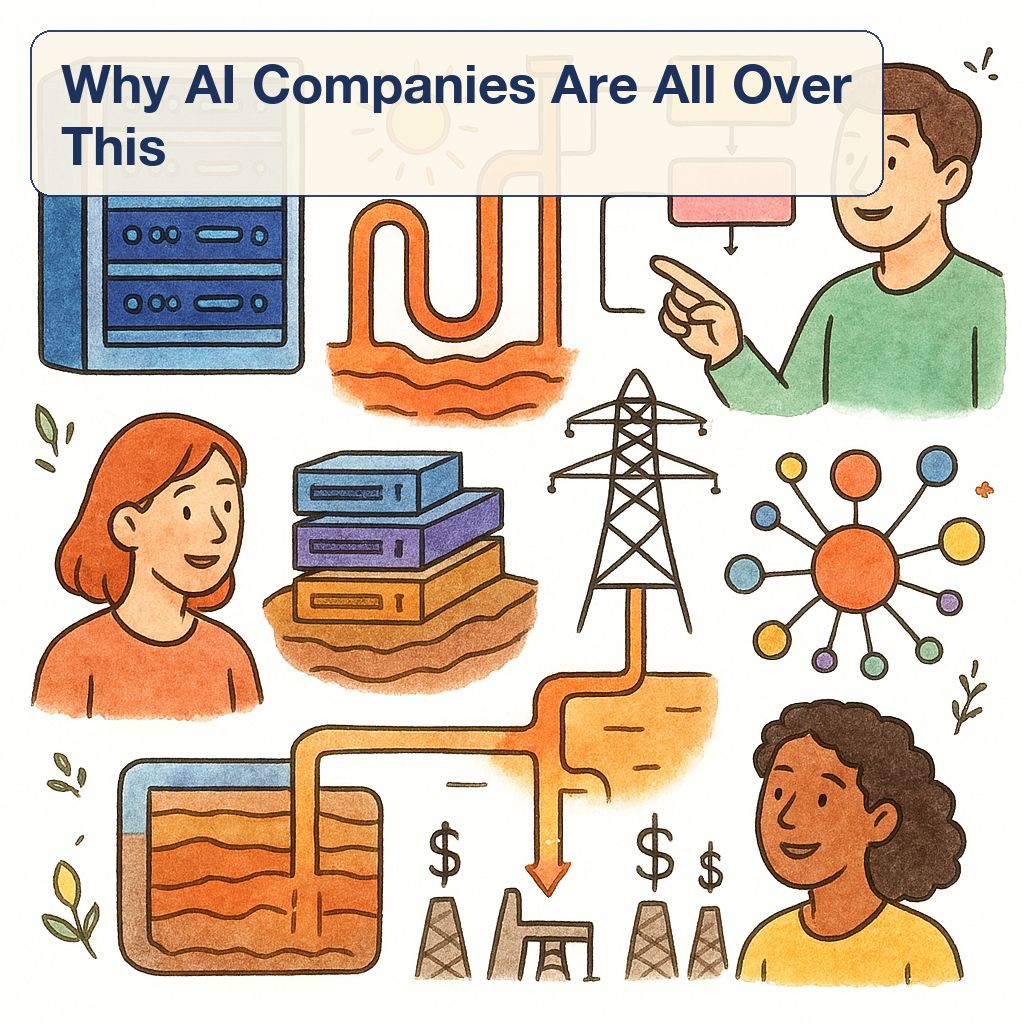
Why AI Companies Are All Over This
Let’s connect the dots to why AI specifically is driving this. It’s not just that AI needs electricity — everything needs electricity. It’s the specific requirements of AI infrastructure that make geothermal uniquely attractive.
Training large language models and running inference at scale requires massive GPU clusters that run continuously. You can’t turn them off when the wind isn’t blowing. You can’t wait until daytime when solar kicks in. Compute workloads are bursty and unpredictable, but the underlying hardware needs constant power just to stay operational. Data center operators describe it as “baseload power with flexible capacity” — you need a guaranteed minimum supply available 24/7, with the ability to ramp up when workloads spike.
📖 Related: Oil Under $100: 3 Moves to Lock In $960 Savings (May 2026)
Geothermal delivers that almost perfectly. It’s not weather-dependent. It doesn’t require fuel deliveries that might get disrupted. It produces steady output around the clock. And because geothermal plants can modulate output by adjusting flow rates, they offer some flexibility to match demand fluctuations — not as quickly as batteries, but faster than nuclear or coal.
Then there’s the corporate commitments. Every major tech company has pledged to reach net-zero emissions or run on 100% renewable energy by 2030 or 2035. They made those promises back when they were much smaller and AI wasn’t eating double-digit percentages of global electricity growth. Now they’re scrambling to figure out how to train GPT-6 or Claude 4 or whatever’s next without blowing up their carbon budgets. Buying renewable energy credits doesn’t cut it anymore — stakeholders want to see actual clean electrons flowing into actual data centers.
Geothermal from converted oil wells is almost narrative perfection for these companies. You’re taking fossil fuel infrastructure — the literal embodiment of the old energy economy — and turning it into clean power for the AI future. It’s transformation, not abandonment. It employs oil workers instead of displacing them. It reuses existing industrial sites instead of consuming new land. If you’re a VP of sustainability at a tech giant, that story writes itself in the annual report.
I’ve been tracking power purchase announcements, and the pattern is clear. Tech companies are signing longer-term deals (15-20 years instead of 5-10) and accepting higher minimum commitments in exchange for guaranteed geothermal supply. They’re treating baseload clean power as strategic infrastructure, not as a commodity they can source on spot markets. That shift in buyer behavior is what makes projects financeable. Banks will lend against 20-year contracts with investment-grade counterparties. They won’t lend against “we hope to sell power at market rates.”
Frequently Asked Questions
Can any abandoned oil well be converted to geothermal power?
No, not every well is a good candidate. You need sufficient depth (usually 2+ kilometers) to access meaningful heat, a geothermal gradient that’s at least average or better, and well casing that’s still structurally sound. Many abandoned wells are too shallow or too degraded to convert economically. The best candidates are relatively recent wells that were shut in for economic reasons rather than structural failure, located in regions with favorable geology.
How long does it take to convert an oil well to geothermal production?
Timeline varies by site condition, but projects can typically move from planning to operation in 12-18 months. That’s dramatically faster than building new power plants or drilling new geothermal wells from scratch, which can take 3-5 years or longer. The speed advantage is one reason AI companies are interested — they need committed power supply on shorter timelines than traditional energy infrastructure can deliver.
Is this technology proven or still experimental?
Enhanced geothermal systems using oil field technology are proven at commercial scale as of 2026. Fervo Energy’s $10 billion IPO in May 2026 demonstrated that institutional investors view this as a mature, investable sector rather than speculative cleantech. Multiple operational projects are delivering power under long-term contracts. The risks are manageable and quantifiable rather than unknown.
How does the cost compare to solar or wind power?
Geothermal conversion projects typically aim for power costs in the 6-8 cents per kilowatt-hour range, which is competitive with utility-scale solar and wind. However, geothermal provides baseload power 24/7 without requiring battery storage, making it more directly comparable to natural gas. When you factor in the cost of batteries needed to make solar or wind provide baseload reliability, geothermal often becomes cost-competitive or even cheaper.
What happens to oil workers in this transition?
This is actually one of the more encouraging clean energy stories for fossil fuel workers. The skills required for geothermal well operations — drilling, completion, subsurface engineering, production optimization — are almost identical to oil and gas work. Workers can transition with minimal retraining. States like Oklahoma are explicitly designing programs around this skills overlap to ensure energy workers benefit from the transition rather than being displaced by it.
What Happens Next
So where does this go? Based on the legislative momentum and Fervo’s demonstration that the business model works, I expect to see significant acceleration through 2026 and 2027. Oklahoma’s March legislation and Fervo’s May IPO probably mark the inflection point where this shifts from “interesting pilot projects” to “actual industry.”
The key variables to watch are power purchase agreements and state permitting timelines. If more AI companies sign long-term geothermal contracts in the coming months, that validates the demand side and unlocks more project financing. If Oklahoma, Texas, and California continue streamlining permits, that addresses the main bottleneck on the supply side. Both trends seem to be moving in the right direction.
The technology isn’t going to change dramatically in the next few years. We’re not waiting for breakthroughs. We’re just scaling up deployment of techniques that already work. That’s actually good news — it means progress depends on execution and policy rather than on hoping for innovations that might never arrive. Enhanced geothermal systems that leverage oil field infrastructure are ready now. The question is how fast we deploy them.
I’ll be watching which companies follow Fervo into the public markets and what valuations they command. If Fervo holds up as a public company and delivers on its projections, expect a wave of private geothermal companies accelerating their own IPO timelines. That would bring more capital into the sector and speed up project development significantly. We might look back at May 2026 as the moment geothermal finally broke out of niche status and became a mainstream power source.
For anyone trying to understand how oil wells generate clean energy and whether this technology actually matters, the answer is increasingly clear: yes, it works, and yes, it’s happening at scale right now. The infrastructure is already built. The technology is proven. The customers are lined up with checkbooks open. Sometimes the best path forward comes from repurposing what we already have rather than building everything new from scratch.