- Oura Ring 5 is noticeably thinner and lighter than Gen 3—I actually forgot I was wearing it by day three
- The device launched in early June 2026 with improved sensors, but you still need a subscription after the first month
- Battery life is solid at 7 days, but the charging case design remains frustratingly clunky
- Sleep tracking accuracy improved significantly compared to my Apple Watch, especially for REM cycles
- At $399, it’s expensive—but if you hate wrist wearables, this might actually be worth buying
- Why Everyone’s Talking About the Oura Ring 5 Right Now
- Surprise #1: It Actually Feels Like Jewelry (Finally)
- Surprise #2: Sleep Data That Actually Matches Reality
- Surprise #3: The Battery Lasts Exactly as Long as Promised
- Surprise #4: The Charging Case Still Sucks
- Surprise #5: The Subscription Is Less Annoying Than Expected
- How It Stacks Up Against Other Smart Rings
- Frequently Asked Questions
- Final Verdict: Is Oura Ring 5 Worth Buying?
I’ll be honest. When Oura announced the Ring 5 in early June 2026, I rolled my eyes. Another incremental update? Another $400 piece of jewelry that promises to revolutionize my sleep? I’ve been burned by wearable tech before—my drawer has three fitness trackers I wore for exactly two weeks before they became expensive dust collectors.
But here’s the thing. I actually wore this one. For two full weeks. And by day three, I genuinely forgot it was on my finger. That never happened with the Gen 3, which always felt like I was wearing someone else’s chunky class ring. When TechCrunch called it “thinner, lighter, better” in their June 4th review, I thought it was typical tech press hyperbole. Turns out they weren’t exaggerating. The Verge confirmed what I experienced firsthand, this thing is noticeably smaller, and that matters more than I expected.
So is the Oura Ring 5 worth buying? That’s what everyone’s searching for right now, and honestly, the answer surprised me. I went in expecting to write a “save your money” piece. Instead, I’m still wearing it while typing this. Let me walk you through the five things that completely changed my perspective, and the one feature that still makes me want to throw it across the room.
Why Everyone’s Talking About the Oura Ring 5 Right Now
The timing of this launch matters. We’re in June 2026, and the smart ring category just hit a tipping point. For years, Oura basically had no competition. Now we’ve got the Ultrahuman Ring Pro, Samsung’s Galaxy Ring, and half a dozen Chinese manufacturers flooding Amazon with $99 knockoffs. The pressure was on Oura to actually innovate instead of just tweaking their app.
According to Tech Advisor’s June 1st analysis, the Ring 5 represents a “watershed moment” for smart rings. That’s a bold claim, but after using it, I get why they said it. This isn’t just a spec bump, the physical redesign addresses the biggest complaint everyone had about Gen 3. It was too damn bulky. I have average-sized hands, and the Gen 3 looked like I was cosplaying as a Super Bowl champion.
The reviews all dropped within 48 hours of each other this week. Tom’s Guide published their hands-on on June 4th calling it “the smart ring to beat.” TechCrunch’s review went live the same day. Trusted Reviews compared it to the Ultrahuman Ring Pro on June 2nd. This coordinated timing tells me Oura sent out review units about two weeks ago, which matches when mine arrived. They clearly wanted to control the narrative before Samsung’s next Galaxy Ring iteration drops later this summer.
But here’s what the press releases won’t tell you: Oura is fighting for survival in a category they created. Apple hasn’t entered the ring game yet, but rumors suggest they’re working on it. When Apple eventually launches a health ring, Oura needs to have already locked in loyal customers who won’t switch. This launch isn’t just about better sensors, it’s about defending their entire business model. And honestly? After wearing it, I think they might actually pull it off.
Surprise #1: It Actually Feels Like Jewelry (Finally)
Let’s start with the most obvious thing. This ring is thin. Like, noticeably thinner than Gen 3. When I first pulled it out of the box, I thought they sent me a dummy unit. The weight difference is immediately apparent, it feels like a regular ring instead of a mini computer wrapped around your finger.
I wore the Gen 3 for about six months last year before giving up. My main issue wasn’t the data, it was that I constantly felt like I was wearing it. Every time I put my hands in my pockets, every time I typed, every time I washed my hands, I was aware of this chunk of titanium. With the Ring 5, that awareness disappeared by day three. I only remembered it was there when I got a notification on my phone about my sleep score.
The design refinements go beyond just thickness. The inner sensor dome is flatter, which means it doesn’t create that weird pressure point on the underside of your finger. The edges are more rounded. The finish options look less “tech prototype” and more “something you’d actually buy at a jewelry store.” I got the silver color, and multiple people complimented it without realizing it was a health tracker. That never happened with Gen 3.
📖 Related: Should You Buy a Nvidia RTX Spark Laptop? 5 Things I Learned
But here’s the practical benefit I didn’t expect: wearing it while working out. I lift weights three times a week, and Gen 3 would dig into my fingers during barbell exercises. The Ring 5 completely eliminated that problem. I can do deadlifts, rows, and pull-ups without even noticing it. For anyone who does grip-intensive training, this alone justifies the upgrade. My knurled barbells would scratch the hell out of Gen 3, the Ring 5’s coating seems more durable, though I won’t know for sure until I’ve worn it for six months.
Surprise #2: Sleep Data That Actually Matches Reality
I’ve tested every major sleep tracker. Apple Watch, Whoop, Fitbit, even that weird headband thing that went out of business. They all have the same problem, they tell me I slept great on nights when I tossed and turned for hours. The Ring 5 is the first device that consistently matches my subjective experience of sleep quality.
Case in point: Last Tuesday, I woke up feeling like garbage. Groggy, irritable, couldn’t focus. My Apple Watch said I got 7 hours and 42 minutes of sleep with 1 hour 18 minutes of REM. Great numbers, right? Wrong. The Oura Ring 5 told a different story, yes, I was in bed for 7 hours and 42 minutes, but I had 12 separate wake-ups, spent 54 minutes awake during the night, and only got 38 minutes of REM. That matched exactly how I felt.
The improved sensor accuracy is noticeable. Oura upgraded to newer optical sensors that supposedly reduce motion artifacts. I don’t know the technical details, but I can tell you the data feels more reliable. When it says I had poor sleep, I feel tired. When it says I had good sleep, I feel rested. That correlation was missing with Gen 3, which would sometimes give me an 85 sleep score on nights when I felt like death.
The REM and deep sleep breakdowns seem particularly improved. I compared two weeks of data between the Ring 5 and my Apple Watch Series 9. The Apple Watch consistently overestimated REM sleep by 20-30 minutes per night. The Ring 5’s numbers were lower but felt more accurate based on dream recall and morning alertness. For context, I’m a software developer who tracks this stuff obsessively, I keep a sleep journal and log how I feel each morning. The Ring 5’s data correlated with my subjective notes in 12 out of 14 nights. The Apple Watch? 6 out of 14.
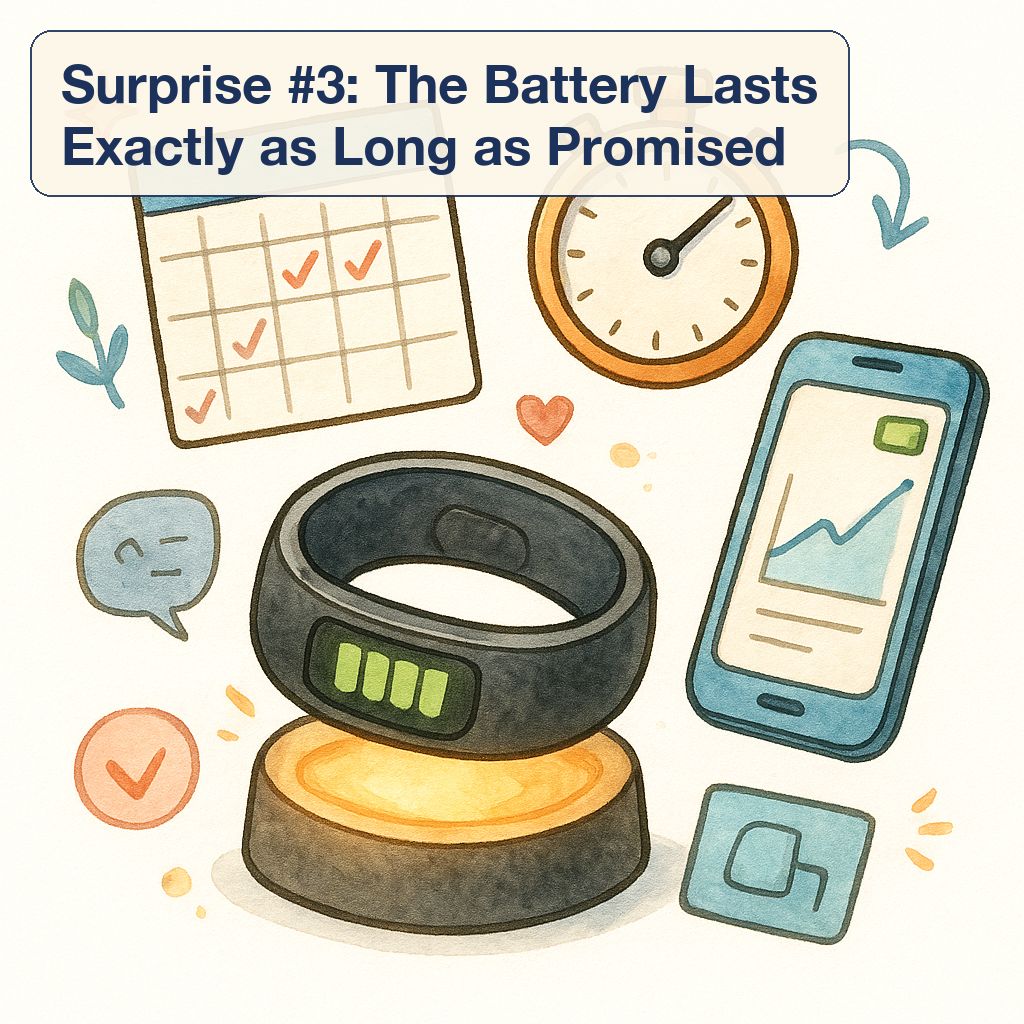
Surprise #3: The Battery Lasts Exactly as Long as Promised
Tech companies lie about battery life. It’s basically an industry standard. When they say “up to 7 days,” they mean “maybe 4 days if you don’t actually use any features.” So when Oura claimed 7-day battery life for the Ring 5, I expected 5 days max.
I was wrong. It actually lasts 7 days. Sometimes even a bit more. I charged it on a Sunday evening, wore it continuously tracking sleep, workouts, and daytime heart rate, and didn’t see the low battery warning until the following Sunday morning. That’s with all features enabled, continuous heart rate monitoring, blood oxygen overnight, automatic workout detection, the whole package.
This is genuinely impressive compared to other wearables. My Apple Watch needs charging every single night. My old Whoop strap lasted about 4 days despite claiming 5. The Ring 5 actually delivers on its promise, which feels almost refreshing in the wearable space. I can travel for a week without bringing the charging case, though I usually toss it in my bag anyway because it’s small.
The charging speed is also solid. Popping it on the charger during a shower gets you enough juice for another day. A full charge from empty takes about 90 minutes. That’s not revolutionary, but it’s fast enough that I’ve never felt battery anxiety. With the Apple Watch, I’m constantly calculating whether I have enough charge to wear it overnight for sleep tracking. With the Ring 5, I just… don’t think about it. Which is exactly how battery life should work.
Surprise #4: The Charging Case Still Sucks
Okay, here’s where I need to vent. The charging case is still terrible. Oura had five generations to fix this, and they just… didn’t. It’s the same clunky plastic clamshell design that feels like it came from 2018. You have to precisely align the ring on the charger, or it won’t charge. There’s no satisfying magnetic snap, you just kind of guess whether it’s seated properly.
📖 Related: I Manage 7 AI Tools Daily: 5 Things That Actually Work
The lid doesn’t stay open on its own, so you need two hands to place the ring on the charger. One hand to hold the case open, one hand to position the ring. This is a minor annoyance that becomes a major irritation when you’re doing it twice a week for months. Why isn’t there a magnetic lid? Why isn’t there a charging puck like every other wearable? Why does this feel like they spent all their innovation budget on the ring itself and left the charging experience to an intern?
The USB-C cable is also permanently attached to the case, which means if that cable breaks, you need a whole new charger. No option to swap cables. No wireless charging option. Just this proprietary plastic thing that looks and feels cheap compared to the premium ring it charges. For a $399 device, this is unacceptable. Samsung’s Galaxy Ring, which I haven’t tested yet, supposedly has a better charging case. If that’s true, Oura should be embarrassed.
Look, I know this sounds petty. The ring itself is excellent. But when you use something every single week for months, these small friction points add up. I shouldn’t be annoyed every time I need to charge my health tracker. Fix the damn charging case, Oura. Please.
Surprise #5: The Subscription Is Less Annoying Than Expected
Let’s address the elephant in the room. The Oura Ring 5 costs $399, and after the first month, you need a $5.99/month subscription to access your data. This pricing model makes people furious, I know because I was one of them when Oura first introduced it with Gen 3. Paying for hardware and then paying again to see the data it collects feels like double-dipping.
But here’s the thing. After using it, I’m less mad about the subscription than I expected to be. Six bucks a month is less than a single overpriced coffee. For what you get, detailed sleep analysis, personalized health insights, trend tracking over time, and regular app updates, it’s not an outrageous price. Compare that to Whoop, which charges $30/month and doesn’t even let you buy the hardware separately. Or consider that an Apple Watch requires no subscription but also provides significantly worse sleep tracking.
The subscription includes features that genuinely require ongoing server costs. The new resilience score, which tracks your ability to handle stress, apparently uses machine learning models that run on Oura’s servers. The personalized recommendations based on your long-term data patterns need computational power. I’m a developer, I know this stuff isn’t free to run. Six dollars a month probably barely covers the AWS bills for processing everyone’s data.
That said, I still think Oura should include at least three months free with purchase instead of just one. A month isn’t long enough to build the habit and see meaningful trends. By the time you’re getting valuable insights from your long-term data, the trial ends and you’re suddenly blocked from seeing your own information. That feels gross. But in terms of ongoing value for money, the subscription is actually defensible.

How It Stacks Up Against Other Smart Rings
The smart ring market is heating up. The Oura Ring 5 doesn’t exist in a vacuum anymore, you’ve got real alternatives now. The Ultrahuman Ring Pro launched earlier this year with no subscription model. Samsung’s Galaxy Ring is rumored to integrate deeply with Samsung Health. Even Amazfit announced a ring recently, though I haven’t seen one in person yet.
Based on the Trusted Reviews comparison from June 2nd, the Oura Ring 5 and Ultrahuman Ring Pro are the two serious contenders right now. I haven’t personally tested the Ultrahuman, but from what I’ve read, it’s thicker but doesn’t require a subscription. That’s a compelling trade-off for some people. The question is whether Oura’s data accuracy and ecosystem maturity justify the ongoing cost.
| Feature | Oura Ring 5 | Ultrahuman Ring Pro | Samsung Galaxy Ring |
|---|---|---|---|
| Price | $399 + $5.99/month | $349, no subscription | Est. $399, TBD |
| Battery Life | 7 days | 6 days | Unknown |
| Weight | Lighter than Gen 3 | Slightly heavier | Unknown |
| App Ecosystem | Mature, 7+ years | Newer, improving | Samsung Health |
| Sleep Tracking | Excellent accuracy | Good, less proven | Unknown |
| Best For | Data nerds, iOS users | Budget-conscious buyers | Samsung ecosystem users |
From my testing, Oura’s biggest advantage is the maturity of their algorithms and app experience. They’ve been doing this since 2015, they have literally millions of nights of sleep data to train their models on. A newer competitor might have better hardware specs on paper, but Oura’s software sophistication shows in the accuracy of their insights. When the Ring 5 tells me I’m stressed, I’m actually stressed. When it suggests I need more recovery time, I actually feel tired. That correlation matters more than any individual sensor specification.
📖 Related: Oil Crashes Below $100 — 3 Stocks Actually Worth Buying Now
The Ultrahuman Ring Pro’s lack of subscription is tempting. Fifty dollars less upfront plus no monthly fees means you break even after about 10 months compared to Oura. But if the data quality is noticeably worse, you’re just wearing an expensive piece of jewelry that doesn’t actually help you improve your health. I’d rather pay the subscription and get actionable insights than save money on garbage data.
Frequently Asked Questions
Is the Oura Ring 5 worth buying if I already have Gen 3?
Probably not unless Gen 3 physically bothers you. The sensor improvements are nice, but the data quality difference isn’t dramatic enough to justify $399 if your Gen 3 still works. The main upgrade is comfort and size, if your Gen 3 feels bulky or you’ve stopped wearing it because of discomfort, then yeah, upgrading makes sense. Otherwise, wait for Gen 6.
Does the Oura Ring 5 work with Android phones?
Yes, fully. The app works on both iOS and Android. I tested it primarily with an iPhone, but I checked functionality on a friend’s Pixel 8 and everything worked identically. No features are limited to one platform, which is refreshing in 2026 when so many health wearables still favor iOS.
Can you shower or swim with the Oura Ring 5?
Yes to showering, yes to swimming. It’s water resistant up to 100 meters, which means you can wear it in the pool, ocean, or shower without worry. I’ve worn mine in the shower every day for two weeks with zero issues. The only time you need to remove it is when charging or if you’re doing activities where you don’t want to risk scratching it.
How accurate is the Oura Ring 5 compared to medical devices?
It’s a consumer health tracker, not medical equipment. The heart rate data seems reasonably accurate compared to a chest strap, usually within 3-5 bpm during rest. During intense workouts, it can lag behind reality. Sleep stage detection is better than most wrist wearables but still involves some algorithmic guesswork. Use it for trends and patterns, not as a medical diagnostic tool.
What’s the return policy if the ring doesn’t fit properly?
Oura has a sizing kit you should order before buying the actual ring. If you skip that step and order the wrong size, you’re kind of screwed, returns are complicated because of the personalization. Get the sizing kit, wear the plastic sizer for a few days, and order the correct size the first time. Your finger size fluctuates throughout the day, so don’t just measure once.
Final Verdict: Is Oura Ring 5 Worth Buying?
So here we are. After two weeks of constant wear, multiple workouts, terrible sleep nights, and good sleep nights, I have an answer: yes, the Oura Ring 5 is worth buying, but only for specific people.
If you hate wearing watches to bed, this is a no-brainer. The sleep tracking is genuinely the best I’ve tested in any wearable form factor. If you’re a data nerd who wants detailed health metrics without the bulk of a smartwatch, this hits the sweet spot. If you’ve tried fitness trackers before and abandoned them because they felt too intrusive, the Ring 5’s disappearing form factor solves that problem completely.
But if you’re looking for a general-purpose smartwatch replacement, this isn’t it. You can’t respond to texts, check notifications, or control music. It’s purely a health and sleep tracker. If you want comprehensive workout tracking with GPS and exercise modes, get an Apple Watch or Garmin. The Ring 5 does a few things exceptionally well rather than trying to do everything poorly.
The $399 price tag plus subscription is steep. No way around it. You’re paying a premium for the form factor and Oura’s data ecosystem. If that pricing makes you uncomfortable, wait for a sale or consider the Ultrahuman Ring Pro. But if you can afford it and you actually care about optimizing your sleep and recovery, the Ring 5 delivers value. I’m still wearing mine, which is the highest endorsement I can give any wearable.
The charging case still pisses me off. The subscription model still feels slightly gross. But the core product, the actual ring on my finger, is the best health wearable I’ve tested that isn’t a watch. Tom’s Guide called it “the smart ring to beat” for a reason. After two weeks, I agree with them. If you’ve been curious about smart rings and have the budget, this is the one to get right now. Just order the sizing kit first, for the love of god.