- Micron stock jumped 12% on May 26, 2026, after UBS tripled its price target from $535 to $1,625
- The company reached a $1 trillion market cap, joining an elite club of tech giants
- AI demand for high-bandwidth memory (HBM) is the primary catalyst driving Wall Street’s bullish outlook
- Valuation concerns remain: the stock trades at significant premiums compared to historical norms
- Whether to buy now depends on your timeline, risk tolerance, and existing semiconductor exposure
If you checked your brokerage app yesterday and saw Micron Technology (MU) up 12% in a single session, you weren’t hallucinating. The memory chip maker just blew past $200 per share and crossed the $1 trillion market cap threshold, putting it in the same valuation territory as Apple, Microsoft, and Nvidia. This isn’t your typical earnings beat rally. We’re talking about one of Wall Street’s most aggressive price target increases ever—UBS literally tripled their forecast from $535 to $1,625 overnight. That’s not a typo.
So naturally, everyone’s asking the same question: should I buy Micron stock now, or did I just miss the boat? I’ve been tracking semiconductor stocks for over a decade, and I’ll be honest—this rally has caught even seasoned investors off guard. The speed of this move, the size of the price target revision, and the timing alongside Trump administration semiconductor policies all create a perfect storm scenario. But perfect storms cut both ways. Let’s break down what’s actually driving this surge, whether the fundamentals justify a trillion-dollar valuation, and what you should do if you’re sitting on cash wondering whether to pull the trigger.
What Just Happened to Micron Stock
On May 26, 2026, Micron stock surged 12% following a bombshell analyst note from UBS. The investment bank didn’t just nudge their price target up a bit—they took it from $535 to $1,625. That’s a 204% increase in their expected upside, one of the largest single revisions I’ve seen for a mega-cap stock. The move pushed Micron’s market capitalization past the $1 trillion mark, a psychological threshold that only a handful of companies have ever breached.
This wasn’t happening in a vacuum. The rally came on the heels of several positive developments for the semiconductor industry. Trump administration policies favoring domestic chip manufacturing have created tailwinds for U.S.-based producers like Micron. Meanwhile, demand for AI infrastructure continues accelerating faster than even optimistic forecasts predicted six months ago. Memory chips—Micron’s bread and butter—are the unsung heroes of this AI boom. Every data center, every AI server, every ChatGPT query relies on massive amounts of high-performance memory.
The stock hit a new all-time high, eclipsing previous peaks from both the 2021 tech bubble and earlier rallies. Trading volume spiked significantly above average, indicating institutional money was piling in, not just retail FOMO. When you see this combination—analyst upgrades, policy support, fundamental demand drivers, and actual dollar flow—it usually signals something more durable than a one-day pop. But that doesn’t automatically make it a buy at current prices.
Here’s what makes this moment different: Micron achieved trillion-dollar status primarily on future expectations rather than current earnings. The company isn’t profitable to the degree that would traditionally justify this valuation. We’re essentially pricing in several years of explosive growth in AI memory demand. That’s either visionary or reckless, depending on whether those growth assumptions actually materialize.
Why This Rally Is Different From 2023
Look, I’ve been burned before by semiconductor rallies that looked unstoppable until they weren’t. The 2023 AI chip surge made a lot of people rich—and left plenty of bag holders when reality set in. So what makes this Micron rally different? Why are smart money managers suddenly comfortable with a $1 trillion valuation for a memory chip company?
First, the policy environment has shifted dramatically. Under the Trump administration, semiconductor manufacturing has become a national security priority. We’re not just talking about subsidies anymore—we’re seeing coordinated efforts to reshore critical chip production. Micron operates major facilities in Idaho and New York, positioning them perfectly to benefit from “America First” chip policies. That’s structural support that didn’t exist during previous rallies.
Second, the AI memory bottleneck is real this time. In 2023, everyone got excited about AI chips generally. Now we’re getting specific about which components matter most. High-bandwidth memory (HBM)—Micron’s specialty—has become the constraint limiting how fast companies can scale AI infrastructure. You can have all the GPUs you want, but without sufficient HBM, those processors sit idle. Micron and Samsung essentially control this market, and demand is outstripping supply by a comfortable margin.
Third, the customer list has matured. Micron isn’t selling to speculative crypto miners or fly-by-night AI startups. Their orderbook includes Microsoft, Google, Amazon, and Meta—companies spending $150+ billion annually on capital expenditures. These aren’t customers who cancel orders when the market hiccups. They’re locked into multi-year AI infrastructure buildouts with no realistic alternative to cutting-edge memory chips.
That said, semiconductor stocks remain cyclical. The difference between 2026 and previous cycles is the depth of structural demand. But cycles are called cycles for a reason—they eventually turn. Anyone buying Micron stock now needs to accept that volatility comes with the territory, trillion-dollar market cap or not.
📖 Related: Should I Buy Nvidia Stock Before China Deal? 3 Moves Now
The AI Memory Gold Rush Explained
Let me break down why Wall Street suddenly thinks Micron is worth more than most countries’ GDP. It comes down to one product category: high-bandwidth memory, or HBM. If you’re not a chip nerd, think of HBM as the ultra-fast memory that sits right next to AI processors, feeding them data at speeds regular RAM can’t touch. Without HBM, advanced AI models literally can’t function.
The economics here are insane. HBM sells for 3-5x the price of conventional memory chips, with significantly better margins. Micron has been ramping HBM production aggressively, and they’re still turning away orders because they can’t make enough. When you have that combination—premium pricing, sold-out capacity, and customers desperate for more—you get the kind of revenue growth that justifies aggressive price targets.
UBS tripled their price target specifically because they recalculated how much HBM revenue Micron could generate over the next three years. Their model assumes AI memory demand grows at a 40%+ compound annual rate through 2029. That might sound aggressive, but consider this: every major tech company is in an arms race to build bigger AI models. Bigger models need exponentially more memory. The math gets crazy fast.
In my portfolio, I’ve been gradually building exposure to this theme since late 2025, but I’ve been selective. The challenge with memory chips is that unlike processors, they’re more commoditized. If Samsung decides to flood the market with HBM, prices could collapse quickly. Micron’s advantage is timing—they’re ramping production exactly as demand is peaking. Whether they can maintain that edge as competitors catch up is the billion-dollar question.
The other factor driving institutional enthusiasm is data center modernization beyond just AI. Cloud providers are upgrading entire server fleets to handle AI workloads, which means replacing older memory modules across millions of machines. That’s a replacement cycle that could run for years, providing a sustained demand floor even if pure AI growth moderates.
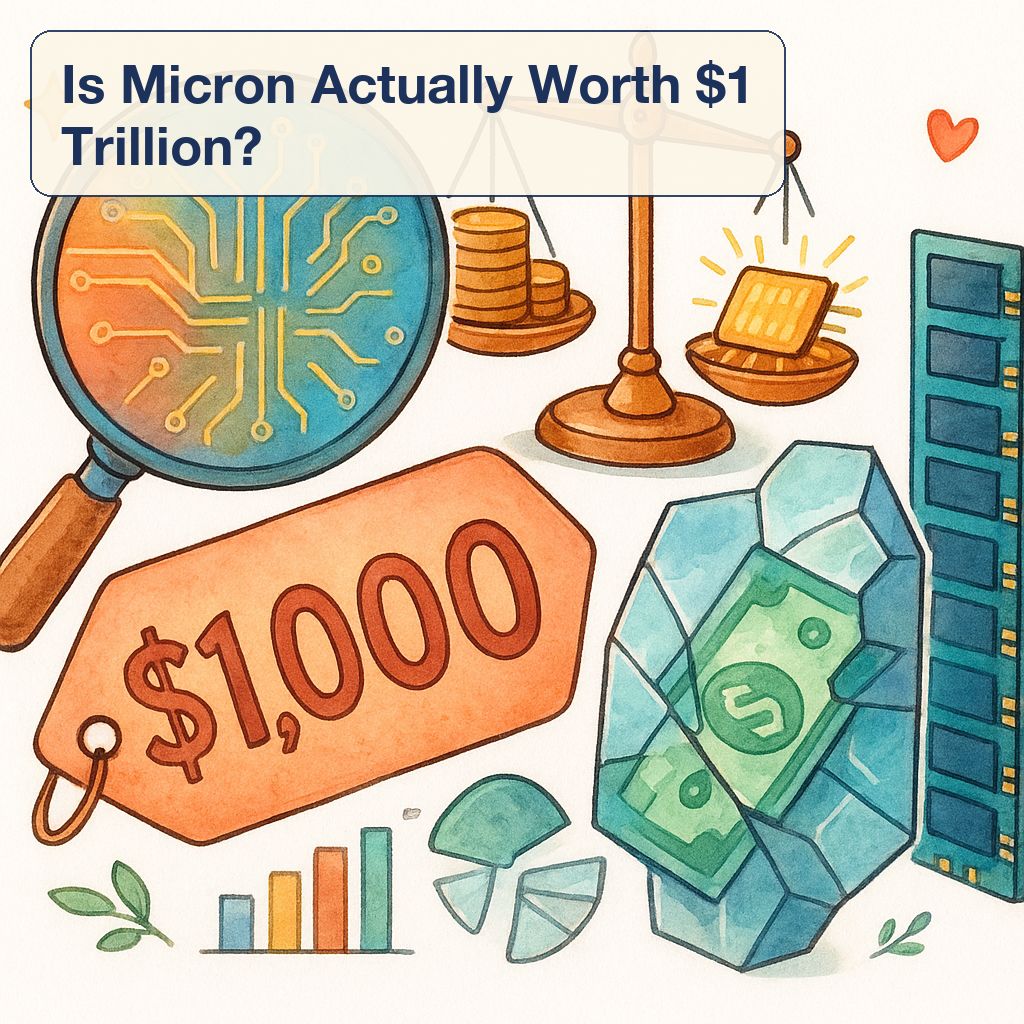
Is Micron Actually Worth $1 Trillion?
Okay, let’s get skeptical for a minute. A trillion dollars is a lot of money. To put Micron’s market cap in perspective, they’re now valued roughly the same as the entire GDP of Indonesia—a country of 275 million people. Does a memory chip company really deserve that valuation?
The bull case relies entirely on forward earnings. If Micron executes on HBM production ramps and captures their projected market share, earnings could reach $50-60 per share by 2028. At that level, even a $1,625 stock price (UBS’s target) would represent a reasonable 27x forward P/E. Not cheap, but not absurd for a company growing earnings 30%+ annually.
The bear case is that we’re pricing in perfection. Memory chip economics are notoriously cyclical. When supply exceeds demand even slightly, prices crater. Micron has gone through brutal downturns before—2019 saw their stock cut in half when memory oversupply hit the market. The difference this time is supposed to be structural AI demand preventing traditional boom-bust cycles. I’m not convinced that’s guaranteed.
| Valuation Metric | Current Level | Historical Average | Assessment |
|---|---|---|---|
| Market Cap | $1 Trillion+ | $50-150B | Extended |
| Forward P/E (2027E) | ~30x | 12-18x | Premium |
| Price/Sales | 8-10x | 2-4x | Stretched |
| Revenue Growth (Est.) | 35-40% | 5-15% | Strong |
What worries me isn’t the absolute valuation—it’s the rate of change. Stocks that triple their market cap in under a year tend to give back gains violently when sentiment shifts. We’ve seen this movie before with Tesla, with crypto stocks, with SPACs. Doesn’t mean Micron can’t keep running, but the risk/reward at $200+ is dramatically different than it was at $100.
One data point in Micron’s favor: institutional ownership has increased significantly. These aren’t day traders chasing momentum—pension funds and endowments are taking positions. That suggests sophisticated investors believe the AI memory thesis has legs beyond a quarterly hype cycle. But it also means there’s a lot of capital that could head for the exits simultaneously if the story cracks.
3 Risks Every Buyer Should Know
If you’re seriously considering whether to buy Micron stock now, you need to understand what could go wrong. I’m not talking about minor pullbacks—I mean scenarios that could cut this stock in half. Here are the three that keep me up at night.
📖 Related: AMD Stock Soars 15%: 3 AI Chip Plays to Buy Now in 2026
Risk #1: The Memory Supply Glut. Samsung and SK Hynix aren’t sitting idle while Micron prints money. Both are ramping HBM production aggressively. If supply starts exceeding demand by 2027, we could see memory prices collapse 30-40% within months. That’s not hypothetical—it’s happened multiple times in the past two decades. Memory chips are quasi-commodities, and pricing power evaporates when supply exceeds demand by even small margins. Micron’s $1 trillion valuation assumes tight supply through 2028. I’m not convinced that’s bankable.
Risk #2: AI Spending Slowdown. Right now, big tech is in an arms race to build AI infrastructure. But what happens when Microsoft, Google, and Amazon finish their initial buildouts? AI capital spending can’t grow 40% annually forever. Eventually it moderates, and when it does, Micron’s growth narrative unravels fast. We saw this exact pattern with 4G infrastructure in 2015—massive buildout followed by a cliff when the upgrade cycle completed. AI might have longer legs, but the risk of peak spending is real.
Risk #3: Geopolitical Disruption. Despite Trump administration support for domestic manufacturing, Micron still relies heavily on Asian supply chains and customers. Any escalation in U.S.-China trade tensions could disrupt operations or cut off key markets. Taiwan Strait risk is particularly acute—if tensions flare, semiconductor stocks typically get hammered regardless of fundamentals. Micron’s Idaho and New York facilities help, but they don’t eliminate geographic concentration risk.
None of these risks are showing up in current price action, which tells me the market is priced for perfection. That’s when I get nervous. The time to buy Micron was probably six months ago when these risks were fully priced in. At a trillion-dollar valuation, there’s not much room for disappointment.
Should I Buy Micron Stock Now or Wait?
Alright, here’s the question everyone actually wants answered: should I buy Micron stock now, pull the trigger today, or wait for a pullback? Frustratingly, the answer is: it depends on your situation.
If you’re a long-term investor with a 5+ year horizon and no existing semiconductor exposure, I’d argue Micron deserves a position—but with major caveats. Don’t make it a huge bet. The stock could easily pull back 20-30% on profit-taking or a single disappointing earnings report. Think of this as a 2-3% portfolio allocation, not a 10-15% concentrated position. The AI memory thesis is compelling enough to warrant exposure, but not at the expense of portfolio balance.
If you’re looking for a near-term trade, honestly, you probably missed the easy money. That 12% jump on May 26 was the move. Chasing momentum here is dangerous—stocks that gap up on massive volume tend to consolidate or pull back before resuming uptrends. I’d wait for a dip back toward $180 or a technical consolidation pattern before adding. Buying breakouts is how retail investors lose money to institutional sellers.
For aggressive investors comfortable with volatility, consider a dollar-cost averaging approach. Buy a third of your intended position now, another third if the stock pulls back 10%, and hold the final third for a deeper correction. This way you get exposure if the rally continues, but you’re not all-in at the top if sentiment shifts. In my own portfolio, I’ve been using this strategy with semiconductor stocks generally, and it’s helped smooth out the insane volatility these names experience.
One timing factor to watch: Micron’s next earnings report. If management guides conservatively or indicates any HBM production delays, this stock could get hit hard. Conversely, if they raise guidance and increase capacity expansion plans, we could see another leg higher. The premium you’re paying at $200+ assumes flawless execution. Any miss gets punished severely at these valuations.

Better Plays in the Chip Sector
Look, I’m not here to talk you out of Micron if you’re convinced the AI memory story is real. But if you’re just looking for semiconductor exposure, there are alternatives worth considering that might offer better risk/reward at current prices.
AMD remains my preferred way to play AI chip demand. They’re taking market share from Intel in data centers and have competitive AI accelerators without Nvidia’s nosebleed valuation. If Nvidia ever stumbles, AMD is the primary beneficiary. Plus they’re trading at a meaningful discount to Micron on a forward P/E basis.
📖 Related: 5 Best AI Chip Stocks to Buy in 2026 (Bernstein Analysis)
Taiwan Semiconductor (TSM) is the boring, diversified play. They manufacture chips for everyone—Apple, Nvidia, AMD, Qualcomm. If semiconductor demand grows, TSMC wins regardless of which specific chip category performs best. Yes, there’s Taiwan geopolitical risk, but you’re getting a 2% dividend yield and much lower valuation multiples than Micron.
Broadcom offers AI exposure through networking chips that connect all those memory modules and processors. They’re less hyped than Micron but equally essential to AI infrastructure buildouts. Valuation is still stretched, but less extreme than Micron’s current levels.
For diversification, consider the VanEck Semiconductor ETF (SMH) rather than picking individual stocks. You get exposure to the whole sector without concentration risk in any single name. SMH has lagged Micron’s recent spike, which means there’s potentially more upside left if the semiconductor rally continues. Plus you avoid the binary risk of Micron-specific execution challenges.
The honest truth? If I didn’t already own Micron from lower prices, I’d probably split new capital between AMD and TSM right now rather than chasing Micron at $200+. The risk/reward just looks better elsewhere in the sector. But that’s my portfolio, not yours.
Frequently Asked Questions
Should I buy Micron stock now or wait for a dip?
If you have no position and want exposure, consider waiting for a 10-15% pullback from current levels before starting a position. Stocks that jump 12% in a day typically consolidate before resuming uptrends. For long-term investors, dollar-cost averaging over 2-3 months reduces the risk of buying at a short-term top.
What is Micron’s price target for 2026?
UBS set a $1,625 price target on May 26, 2026, tripling their previous target of $535. This is Wall Street’s most bullish target for Micron, based on aggressive assumptions about AI memory demand growth through 2028. Other analysts have more conservative targets in the $800-1,200 range.
Is Micron overvalued at $1 trillion market cap?
At current levels, Micron trades at significant premiums to historical valuation norms—roughly 30x forward earnings versus a 12-18x historical average. Whether it’s overvalued depends entirely on whether AI memory demand meets bullish projections. If HBM revenue grows as expected, current valuations could prove justified by 2028.
What percentage of Micron’s revenue comes from AI chips?
Micron doesn’t break out AI-specific revenue, but high-bandwidth memory (HBM) used in AI servers is the fastest-growing segment. Analysts estimate HBM could reach 20-30% of total revenue by 2027, up from low single digits in 2024. This shift to higher-margin products is a key driver of the bullish thesis.
Will Micron stock split soon?
Micron has not announced any stock split plans as of May 2026. While the $200+ share price might seem high, many companies now trade at similar or higher nominal prices without splitting. Management typically considers splits when they believe high share prices create accessibility barriers for retail investors.
Final Take
So should I buy Micron stock now? If you forced me to give a binary answer, I’d say: only if you’re comfortable with significant downside risk and have a multi-year time horizon. The AI memory thesis is real—Micron sits at the center of a genuine technological shift that could drive years of growth. High-bandwidth memory is a chokepoint in AI infrastructure, and Micron controls significant market share in a supply-constrained market. Those fundamentals justify premium valuations.
But a $1 trillion market cap represents an extraordinary amount of optimism already priced in. The stock jumped 12% in a single day after UBS tripled their price target to $1,625. That’s a lot of good news already reflected in the current price. When I see moves like this, my instinct is to trim positions rather than add. The easy money was made at $100-150. What’s left now is either the second leg of a historic rally or an expensive lesson in momentum chasing.
For most investors, the prudent move is patience. Watch how Micron performs over the next quarter. See if HBM production ramps meet expectations. Monitor whether AI capital spending remains robust or shows signs of moderating. If the thesis holds up and the stock consolidates or dips, you’ll get a better entry point with clearer visibility. If it keeps ripping higher without you, well, there’s always the next opportunity. FOMO is not an investment strategy.
In my own portfolio, I’m holding existing Micron shares but not adding at these levels. The risk/reward has shifted too far toward risk for my taste. That could prove wrong if this rally has another 50% left in it, but I’m okay missing some upside to avoid a potentially painful drawdown. Trillion-dollar valuations don’t provide much cushion when sentiment shifts. Trade accordingly, know your risk tolerance, and never bet more than you can afford to lose on any single stock—especially one as volatile as semiconductors.