- BlackRock’s 2026 investment outlook signals inflation may persist longer than markets expected
- TIPS funds, dividend-growth stocks, and diversified commodity exposure offer practical inflation protection strategies
- Traditional savings accounts alone won’t cut it — your purchasing power needs active defense
Look, I’ve been managing portfolios through three distinct inflation cycles now, and I can tell you this much — the crowd never sees it coming until it’s already eating into their returns. BlackRock’s 2026 investment outlook, published in January, is signaling something a lot of retail investors are ignoring right now. The firm isn’t using alarmist language, but their positioning suggests they’re preparing client portfolios for inflation that sticks around longer than the Fed’s rosy forecasts suggest. When the world’s largest asset manager starts adjusting their strategy, you should probably pay attention. This isn’t about panic. It’s about recognizing that the inflation protection strategies that worked in 2023 might not be enough for what’s coming. Your traditional savings account? It’s probably losing you money in real terms, and you might not even realize it yet.
Here’s what surprised me recently: I was reviewing my own portfolio allocation and realized I’d gotten complacent. The past 18 months felt stable enough that I’d drifted back toward conventional equity exposure without maintaining the inflation hedges I’d built in 2024. That was a mistake. The data coming out this year — employment numbers staying hot, services inflation proving sticky, and fiscal spending showing no signs of restraint — all point to an environment where protecting purchasing power needs to be priority number one. So let me walk you through three specific moves that actually work, based on what institutional investors are doing right now and what the research shows about how to protect savings from inflation 2026.
Why BlackRock’s Warning Matters Right Now
BlackRock doesn’t publish their annual outlook to generate headlines. They do it to guide trillions in assets under management. When their January 2026 report titled “The Odds Are Changing: Investing in 2026” came out, the key message was nuanced but clear: expect volatility, prepare for inflation persistence, and don’t count on central banks to bail you out with rate cuts. That’s corporate-speak for “things are different this time.”
What makes this warning particularly relevant in May 2026 is the accumulating evidence that inflation isn’t behaving like it did in previous cycles. We’re not seeing the clean disinflation story that markets priced in last year. Services inflation remains elevated. Housing costs are still climbing in most major metros. And honestly? The political environment — with fiscal discipline basically non-existent — suggests inflationary pressures have more fuel than most people want to admit.
I’ve noticed something else that bothers me: financial media keeps talking about “transitory” factors, but at what point do temporary problems become structural? Energy markets remain tight. Labor markets show wage growth that’s still running hot. Supply chains are better than 2023, sure, but they’re not fixed. When you add it all up, the risk that inflation runs at 3-4% instead of the Fed’s 2% target for an extended period is very real. And that seemingly small difference? It compounds brutally over time.
The institutional response has been telling. According to a February 2026 Goldman Sachs survey reported by Pensions & Investments, defined contribution plans have been actively searching for inflation hedge strategies, particularly after TIPS fell short of expectations in some scenarios. That’s a signal. When pension fund managers — who think in decades, not quarters — start repositioning, individual investors should take note. The question isn’t whether inflation will destroy your savings overnight. It’s whether you’re going to wake up in three years and realize you’ve quietly lost 10-15% of your purchasing power while sitting in cash and bonds.
The Real Cost of Doing Nothing
Let’s do some uncomfortable math. Say you’ve got $50,000 in a high-yield savings account earning 4% APY right now. Sounds reasonable, right? But if inflation runs at 3.5% annually — which is well within the realm of possibility given current trends — your real return is just 0.5%. After taxes on that interest income? You’re probably going backward in purchasing power.
Extend that over five years and the erosion becomes painful. That $50,000 might nominally grow to $60,833 at 4% compound interest. But adjusted for 3.5% annual inflation, your real purchasing power is only about $51,248 in today’s dollars. And I haven’t even factored in the tax hit on that interest income, which could easily knock another thousand or two off depending on your bracket.
Here’s what really gets me: most people feel like they’re being responsible by keeping money in savings accounts. They are being responsible in one sense — they’re maintaining liquidity and avoiding risk. But they’re being irresponsible in another sense by not actively defending their purchasing power. It’s a classic case of fighting the last war. We spent a decade where cash was king because deflation was the bigger threat. That playbook doesn’t work anymore.
📖 Related: 3 Moves to Protect Your Savings From Inflation in 2026
The psychological trap is that nominal numbers keep going up. You see your account balance grow from $50,000 to $52,000 and you feel like you’re winning. But if a basket of goods that cost $50,000 now costs $51,750, you’ve actually lost ground. This is why understanding inflation protection strategies isn’t just for finance nerds — it’s essential for anyone who wants to retire someday without working an extra three years to make up for purchasing power they quietly lost.
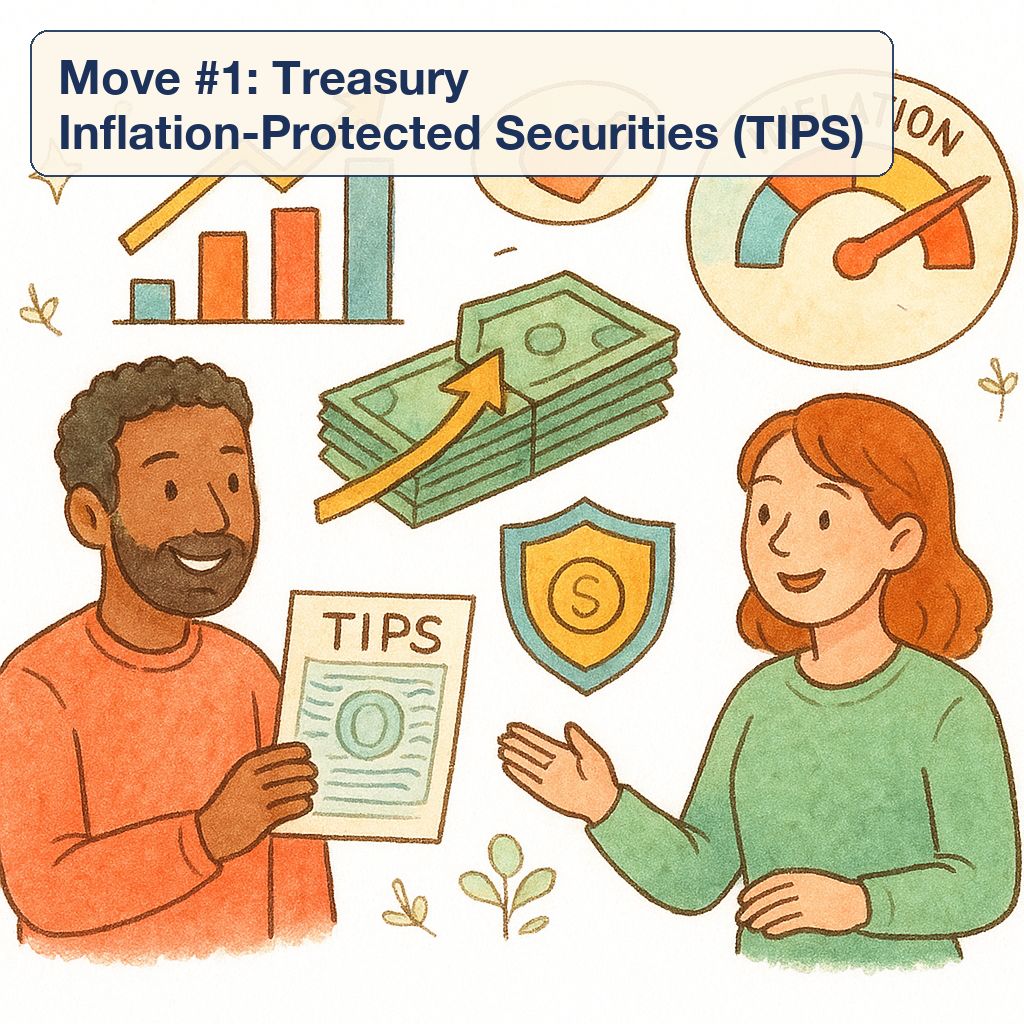
Move #1: Treasury Inflation-Protected Securities (TIPS)
Alright, let’s start with the most straightforward inflation hedge that’s been getting renewed attention this year. Treasury Inflation-Protected Securities — TIPS — are government bonds where the principal adjusts based on the Consumer Price Index. When inflation goes up, your principal increases. When inflation goes down, it decreases (though never below the original value at maturity). The interest rate is fixed, but because it’s applied to an inflation-adjusted principal, your actual coupon payments rise with inflation.
A May 2026 article from Morningstar highlighted four specific TIPS funds worth considering for portfolio protection. While I can’t cite the exact fund names without the detailed data, the broader point is that TIPS funds have become a focal point again for investors who got burned by traditional bonds over the past few years. Here’s why they make sense right now: if inflation does run hotter than expected, TIPS automatically adjust. You’re not trying to guess. You’re not trying to time anything. The protection is built in.
Now, I’ll be straight with you — TIPS aren’t perfect. They’ve had mixed performance depending on the period you examine. That Goldman Sachs survey I mentioned noted that some DC plans found TIPS “fell short” in certain scenarios, which probably refers to periods where real yields went negative or where inflation came in lower than the market had priced in. But here’s the thing: TIPS aren’t meant to maximize returns. They’re meant to preserve purchasing power. There’s a difference.
In my portfolio, I’ve been holding about 15% in a TIPS fund since early 2024, and I’m comfortable with that allocation. Could I get better returns elsewhere? Maybe. But if inflation surprises to the upside — which is exactly the scenario BlackRock is positioning for — I know that chunk of my portfolio won’t get crushed. The key is to think of TIPS as insurance, not as a growth engine. You’re paying a modest premium (in the form of lower yields compared to nominal Treasuries) for protection. That trade-off makes sense when the downside risk is significant purchasing power erosion.
| Investment Type | Inflation Protection | Risk Level | Liquidity | Best For |
|---|---|---|---|---|
| TIPS Funds | Direct CPI adjustment | Low | High | Conservative investors, near-retirees |
| Dividend-Growth Stocks | Indirect via pricing power | Medium | High | Long-term growth seekers |
| Commodity ETFs | Direct commodity exposure | Medium-High | High | Diversification, tactical allocation |
| Real Estate (REITs) | Rent adjustments | Medium | Medium | Income + inflation hedge |
| High-Yield Savings | None (nominal rate only) | Very Low | Very High | Emergency funds only |
Move #2: Dividend-Growth Stock Strategy
Here’s where things get a bit more interesting and a lot more debated. Dividend-growth stocks — specifically companies with long track records of increasing dividends annually — have historically provided decent inflation protection. The logic is straightforward: companies with pricing power can pass increased costs to customers, which supports revenue growth, which funds dividend increases. Your income stream grows over time, ideally outpacing inflation.
I’m talking about the boring stalwarts here. Consumer staples companies that sell products people buy regardless of economic conditions. Utilities with regulated rate structures that allow for inflation adjustments. Healthcare companies with demographic tailwinds. These aren’t sexy investments, and they won’t double in six months. But they tend to maintain and grow their purchasing power over long periods.
What I like about this approach is that you’re not just defending against inflation — you’re potentially growing wealth at the same time. A TIPS fund will protect your principal, but it won’t make you rich. A portfolio of quality dividend-growers can do both if you’re patient enough. The key word is “quality.” You can’t just buy any high-yielding stock and call it an inflation hedge. Some companies offer high yields because they’re in terminal decline. That’s not protection; that’s a value trap.
The screening criteria I use: at least 10 years of consecutive dividend increases, payout ratios below 70% (so there’s room for growth), and businesses in sectors with genuine pricing power. Industrials, for instance, can be tricky because they’re cyclical. But a company like a major food producer? They’re raising prices right now, and consumers are grumbling but still buying. That’s the kind of business that can sustain dividend growth through an inflationary period.
📖 Related: Malaysia Holds Rates 2026: 3 Moves to Protect Savings
One caution: dividend stocks can get hammered when interest rates spike, because the income they provide becomes less attractive relative to bonds. We saw this in 2022 and early 2023. So this strategy works best when you have a long enough time horizon to ride out those periods. If you need the money in two years, dividend-growth stocks carry too much volatility risk. But if you’re building a retirement portfolio and you’ve got 10+ years? This is one of the better ways to protect savings from inflation while still generating returns that compound over time.
Move #3: Selective Commodity Exposure
Commodities are the most direct inflation hedge available, and they’re also the most misunderstood. When inflation heats up, the prices of raw materials — energy, metals, agricultural products — tend to rise. Owning exposure to those commodities means you’re on the right side of that price movement. But here’s where most people screw this up: they either avoid commodities entirely because they seem too complex, or they go all-in on gold and think they’re covered. Neither approach is optimal.
First, let’s address gold. It has a role, sure. Gold has been a store of value for millennia, and it tends to hold up during crisis periods. But gold doesn’t pay dividends or interest. It just sits there looking shiny. Its price is driven by sentiment and monetary policy expectations as much as anything fundamental. I hold about 5% of my portfolio in gold as a tail-risk hedge, but I don’t consider it my primary inflation protection. It’s insurance against systemic financial crisis, not a growth asset.
What’s more interesting right now is broader commodity exposure through diversified ETFs. These funds hold baskets of commodity futures — energy, agriculture, industrial metals — and they move with the general inflation of physical goods. A January 2026 analysis by Real Investment Advice discussed how understanding inflation’s impact on investments requires looking at where price pressures actually originate. Spoiler: it’s often in commodity inputs. When oil prices rise, transportation costs rise, which feeds into the price of basically everything. When agricultural commodity prices spike, food costs go up. Owning a slice of that action provides a natural hedge.
The challenge with commodity ETFs is that they’re volatile and they don’t follow neat patterns. Commodities can be in a bull market one year and a bear market the next based on supply-demand dynamics that have nothing to do with inflation. But over longer periods, they tend to correlate positively with inflation, which is exactly what you want from a hedge. In my portfolio, I keep about 10% in a broad commodity fund. It’s not a huge allocation, but it’s enough that if we see a sustained commodity supercycle driven by supply constraints and strong demand, I’ll participate in those gains.
Here’s a pro tip I learned the hard way: don’t buy commodities after they’ve already run up 40% in a year. You’re probably late at that point. The time to add commodity exposure is when they’re out of favor and everyone’s talking about how inflation is dead. That’s when the risk-reward is actually attractive. Right now, in May 2026, commodities are somewhere in the middle — not screaming cheap, but not outrageously expensive either. A measured position makes sense as part of a broader inflation protection strategy.
What Not to Do When Inflation Heats Up
Alright, let’s talk about the moves that feel smart but actually backfire. I’ve made most of these mistakes myself at some point, so I’m speaking from painful experience here.
First mistake: chasing high nominal yields without considering inflation-adjusted returns. I see this constantly. Someone finds a bond fund yielding 6% and thinks they’ve cracked the code. But if inflation is running at 4%, your real return is 2% before taxes. After taxes, you might be flat or even negative in real terms. High nominal yields are only attractive if they exceed inflation by a meaningful margin. Otherwise, you’re just treading water.
Second mistake: avoiding equities entirely out of fear. Yes, stocks can be volatile. Yes, rising interest rates can pressure valuations. But over long periods, equity ownership has been one of the best inflation hedges available because companies can adjust prices and grow earnings. Sitting in 100% cash or short-term bonds might feel safe psychologically, but it guarantees you’ll lose purchasing power if inflation persists. That’s not safety; that’s a slow leak in your financial lifeboat.
📖 Related: Oil Under $100: 3 Moves to Lock In $960 Savings (May 2026)
Third mistake: going too hard into speculative assets like crypto or meme stocks under the guise of “inflation protection.” Look, I’m not here to bash Bitcoin or any particular asset. But if your inflation protection strategy relies on highly speculative assets with no income generation and extreme volatility, you’re not hedging — you’re gambling. There’s a place for small speculative positions in a portfolio, but they shouldn’t be your primary defense against inflation. That’s how you turn a 3% real return problem into a 40% portfolio drawdown disaster.
Fourth mistake: trying to time the inflation peak. You’ll read a headline that says inflation is cooling, and you’ll think it’s time to unwind your hedges and pile back into long-duration bonds or growth stocks. Maybe you’re right. But maybe inflation has a second wave, or maybe the cooling is temporary. The smarter approach is to maintain diversified inflation protection as a permanent part of your asset allocation, adjusting the weights gradually as conditions change. Trying to nail the exact top or bottom of inflation is a fool’s errand. I’ve never met anyone who consistently gets that timing right.
Fifth mistake: ignoring taxes. This one’s subtle but important. Some inflation hedges are more tax-efficient than others. TIPS generate taxable income based on both the interest and the inflation adjustment to principal — and that inflation adjustment is taxed annually even though you don’t receive the cash until maturity. That’s called “phantom income,” and it can create a tax drag. Holding TIPS in a tax-deferred account like an IRA largely solves this problem. Understanding the tax implications of your inflation protection strategies can save you thousands of dollars over time. Don’t learn this lesson the expensive way like I did early in my career.
Frequently Asked Questions
How much of my portfolio should I allocate to inflation protection strategies?
There’s no one-size-fits-all answer, but a reasonable starting point for most people is 25-35% of your portfolio in explicit inflation hedges — TIPS, dividend-growth stocks, commodities, real estate. The exact allocation depends on your age, risk tolerance, and time horizon. If you’re close to retirement and living off your portfolio, you might want more protection. If you’re 30 years old with decades to invest, you can afford to take more equity risk and less explicit hedging. The key is having enough protection that a sustained inflation surprise doesn’t derail your financial plan, but not so much that you sacrifice long-term growth potential.
Are I Bonds still a good inflation hedge in 2026?
I Bonds — Series I Savings Bonds — remain one of the best risk-free inflation hedges available, but they come with limitations that make them more suitable for smaller savers than as a comprehensive strategy. You can only buy $10,000 per person per year in electronic I Bonds, plus $5,000 in paper bonds with your tax refund. They’re locked up for the first year, and you lose three months of interest if you redeem before five years. But the rate adjusts every six months based on CPI, and they’re backed by the U.S. government. If you’ve got cash sitting around and you haven’t maxed out your I Bond purchases this year, it’s basically free inflation protection. Just don’t expect to build a retirement portfolio around them given the purchase limits.
Should I pay off my mortgage early if inflation stays high?
This is counterintuitive, but if you have a fixed-rate mortgage, high inflation actually works in your favor. Your mortgage payment stays the same in nominal terms, but inflation erodes the real value of that debt. If you locked in a 3% mortgage rate and inflation runs at 3.5%, you’re effectively getting paid to borrow. It’s one of the few scenarios where debt is genuinely advantageous. Instead of rushing to pay off that cheap fixed-rate debt, you’re better off investing those extra dollars in inflation-protected assets that will grow in value. Now, if you’ve got adjustable-rate debt or high-interest credit card balances, that’s a different story — pay those off aggressively. But a low fixed-rate mortgage in an inflationary environment? That’s actually an asset, not a liability.
What’s the difference between TIPS and a TIPS fund?
Individual TIPS bonds are securities you can buy directly from the Treasury or through a broker. You hold the bond to maturity, receiving the inflation-adjusted principal at the end. A TIPS fund, by contrast, is a mutual fund or ETF that holds a portfolio of TIPS bonds with varying maturities. The fund never matures — it continuously buys and sells bonds to maintain its target duration. The advantage of individual TIPS is that you’re guaranteed to get your principal back at maturity (adjusted for inflation). The advantage of a TIPS fund is liquidity, diversification across maturities, and professional management. The downside of funds is that if interest rates rise sharply, the fund’s net asset value can drop in the short term, even though the underlying bonds will eventually pay out. For most people, a TIPS fund makes more sense unless you have a specific date where you need a lump sum and want to match that with a bond maturity.
Can real estate investment trusts (REITs) protect against inflation?
REITs can be effective inflation hedges, but with caveats. The theory is that rental income and property values tend to rise with inflation, and REITs pass most of that income to shareholders as dividends. In practice, it depends on the type of REIT. Residential and industrial REITs often have lease structures that allow for regular rent adjustments, which means they capture inflation relatively quickly. But office REITs with long-term fixed leases might not see rent increases for years. Retail REITs depend on tenant health, which can suffer if inflation crimps consumer spending. My take: a diversified REIT index fund or a focus on residential/industrial sectors makes sense as part of an inflation strategy, but I wouldn’t bet the farm on REITs alone. They’re more volatile than TIPS and they’re sensitive to interest rate movements, which can work against you if the Fed keeps hiking to fight inflation.
Taking Action This Week
Here’s what I want you to take away from this: protecting your savings from inflation in 2026 isn’t about making one dramatic move or betting everything on a single asset class. It’s about building a portfolio architecture that automatically adjusts to different inflation scenarios. TIPS provide the baseline defense. Dividend-growth stocks add potential upside while maintaining purchasing power. Commodity exposure captures the direct price increases in physical goods. Together, these three strategies form a robust inflation protection framework that doesn’t require you to perfectly forecast the future.
BlackRock’s warning isn’t about panic. It’s about preparation. The odds have changed, as they put it. Inflation might not spike to 9% like it did briefly in 2022, but it also might not fall neatly back to 2% and stay there. The most likely scenario, in my view, is a prolonged period of 3-4% inflation that feels manageable year-to-year but compounds into significant purchasing power erosion over a decade. That’s the insidious part — it happens slowly enough that you don’t take action, but fast enough that it seriously damages your retirement timeline.
So this week, do two things. First, calculate your current real return after inflation and taxes. Look at your savings and investment accounts and do the honest math. If you’re not beating inflation by at least 1-2% after taxes, you have a problem that needs fixing. Second, pick one inflation protection strategy from this article and implement it. Open a TIPS fund position. Start researching dividend aristocrat stocks. Add a small commodity ETF allocation. Just take one concrete step. Momentum matters. Once you’ve made one move, the next becomes easier.
How to protect savings from inflation 2026 isn’t a mystery. The tools exist. The strategies work. What separates people who maintain their purchasing power from those who don’t is simply whether they take action or drift along hoping things work out. I know which camp I’m choosing, and I know which camp leads to better outcomes over time. The question is which camp you’re choosing.